
The Roundhill Sports Betting & iGaming ETF, which invests in a basket of gaming companies, closed in the green last week even as the S&P 500 Index fell 1.4%. BETZ has outperformed the broader markets for two consecutive weeks but is still underperforming year-to-date (YTD).
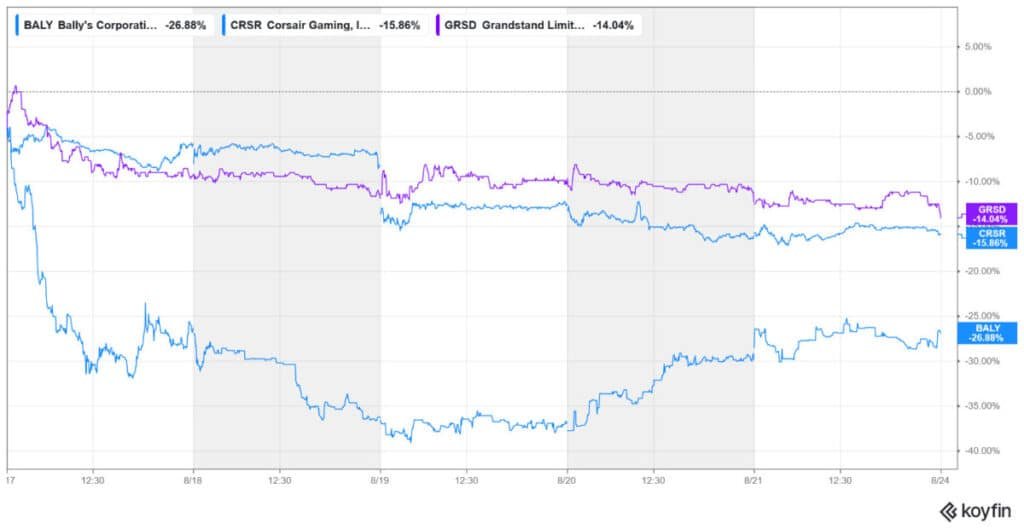
Robinhood Markets and Evolution Ab were among the major gainers last week, while Bally’s Corporation and Corsair Gaming were the major losers.
Biggest Gainers
Robinhood Markets (NYSE: HOOD) +13.15%
Robinhood stock rose over 13% last week, which helped it narrow its YTD losses to under 4.5%. The rise had little to do with the company’s burgeoning prediction-markets business and was largely due to optimism about its cryptocurrency-trading segment.
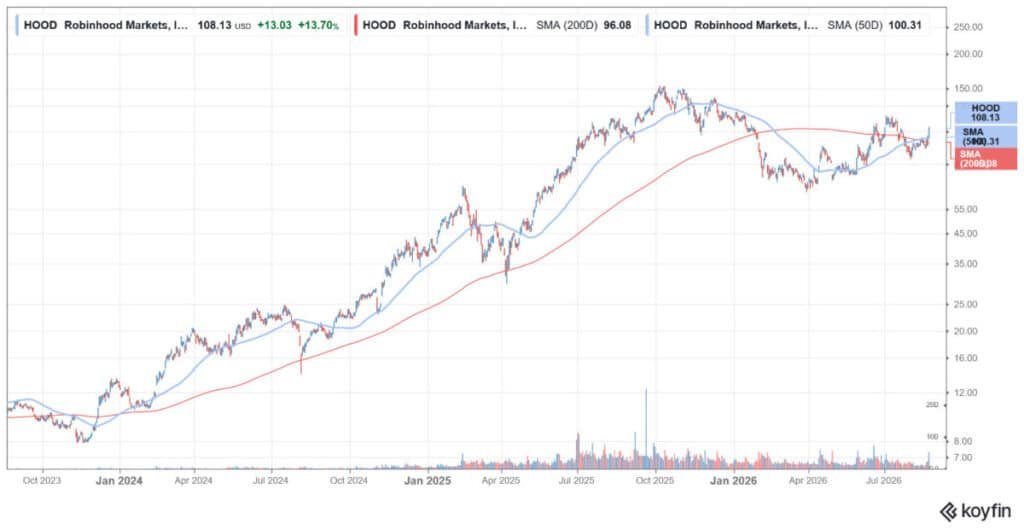
At a crypto summit hosted at the White House, President Donald Trump advocated for the passage of the federal Clarity Act to establish a standardized, predictable regulatory framework for digital assets.
Investor sentiment was further boosted by news around the SEC’s proposed “Regulation Crypto Assets” framework. The proposed rules aim to create a national framework to preempt fragmented state securities laws for tokenized contracts, paving the way for Robinhood to expand its tokenization and 24-hour trading products.
Cryptocurrency trading has been a weak link in Robinhood’s overall business over the last few quarters, and there are signs of a revival in digital assets following the White House’s intervention. Coinbase stock also added over a quarter to its market cap last week amid the rise in bitcoin, which surged towards $80,000 and had its best week in three years.
Evolution Ab (STO: EVO) +8.90%
Evolution Ab stock rose nearly 9% last week and extended its YTD gains to an impressive 30%. Last week, investment bank ABG Sundal Collier upgraded Evolution AB to a “buy” and raised its target price from SEK 675 to SEK 1,000. The note highlighted a strong growth recovery path and solid underlying earnings momentum, sparking renewed institutional buying.
Investor sentiment also continues to react to the top shareholder, Candle Lake Limited (controlled by U.S. investor Kenneth Dart), crossing the 30% voting threshold, which triggered a mandatory takeover cash offer framework. Even though the stock is trading well above the mandatory bid level of SEK 695, the process has established a clear market valuation floor.
Meanwhile, Candle Lake has stressed that it is not looking to acquire the company. In a statement, it said, “Candle Lake is a long-term investor and views its shareholding in Evolution as a financial investment in a well-managed, highly profitable business. The offer is not motivated by any intention to acquire all outstanding shares in Evolution.”
Incidentally, Candle Lake also recently disclosed a 5.8% stake in DraftKings.
The Rank Group Plc (LSE: RNK) +5.81%
The Rank Group shares rose nearly 6% last week. The stock has been in an uptrend since the preceding week, when it posted strong full-year results with underlying profits reaching £78.6 million, noting that its digital performance helped absorb a significant 40% duty burden in the UK.
Biggest Losers
Bally’s Corporation (NYSE: BALY) –26.88%
With a loss of nearly 27% last week, Bally’s Corporation was the biggest loser in our coverage of gaming stocks. In its Q2 financial disclosure filed with the SEC, Bally’s said that based on current forecasts, it does not expect to meet certain debt leverage and liquidity requirements under its revolving credit facility. The company explicitly cited “substantial doubt” about its ability to continue as a going concern, triggering concern among institutional and retail investors.
In its filing, it said, “In response to these conditions, the Company is pursuing a number of financing alternatives intended to enhance its liquidity, including asset monetization, an equity sale, and debt financings.”
Bally’s, however, noted that there is no assurance that the plans would be implemented successfully and therefore “the Company has concluded that management’s plans do not alleviate substantial doubt about the Company’s ability to continue as a going concern.”
Notably, Bally’s stretched balance sheet has been a lingering concern, and earlier this year Moody’s downgraded the company’s Corporate Family Rating to B3, pointing to elevated debt-to-EBITDA ratios as development commitments continue to weigh on cash generation.
Meanwhile, following the going concern warning, analysts across major firms downgraded ratings or slashed price targets following the earnings report. Truist lowered its target from $15 to $10, and Macquarie cut its target from $13 to $11. Barclays, which already has an “underweight” rating on BALY, further lowered its target price by $1 to $7.
Corsair Gaming (NYSE: CRSR) –15.86%
Corsair Gaming stock continues to whipsaw this year and fell nearly 16% last week, even though it is still up a cool 84% for the year. The stock was also among the major losers in the preceding week in a typical profit-booking exercise following the 35% gains in the week before, after the company’s Q2 profitability blew past estimates.
The profit-taking exercise seems to have continued last week as well. Sentiments were also dampened after Goldman Sachs initiated coverage on Corsair Gaming with a Sell rating and an $11 price target. It was a reality check for the stock, which has soared this year amid the optimism about its artificial intelligence (AI) business.
Grandstand Limited (NYSE: GRSD) –14.04%
Grandstand Limited also faced a reality check and fell over 14% last week after making it to the list of biggest gainers in the preceding week with a rise of 20% when investors reacted positively to its Q2 earnings.
The financial performance wasn’t as stellar as the price movement suggests, and the company’s revenues actually fell by 5%. However, Grandstand reiterated its full-year guidance of $165–$170 million in revenue and $45–$50 million in adjusted EBITDA, which reassured markets about a recovery in business in the back half of the year.
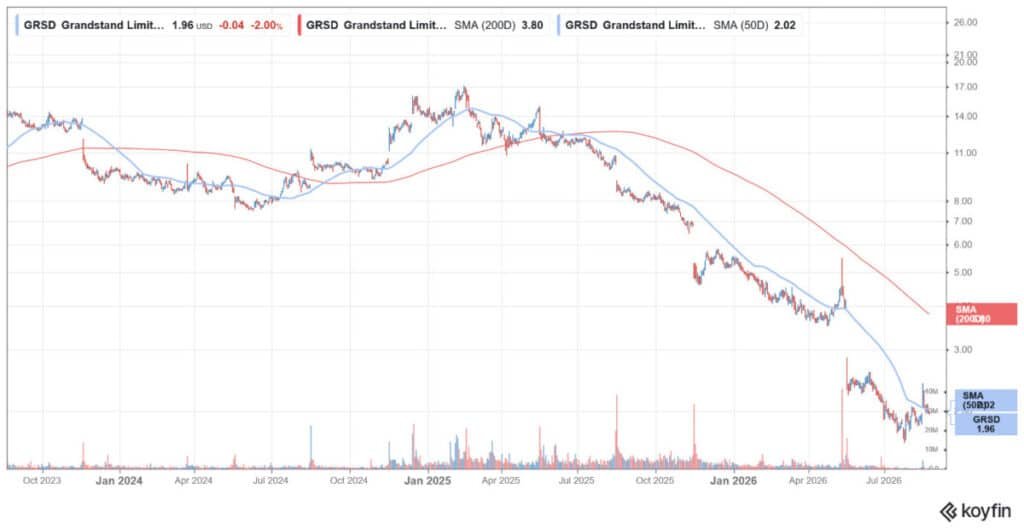
Notably, Grandstand was previously known as Gambling.com, its flagship site. However, the company has since diversified, prompting it to change its name last month.
Major Gaming Industry Developments
Florida Attorney General James Uthmeier filed lawsuits against major sweepstakes casino operators VGW and Stake. Uthmeier also included payment processors as defendants in the claims.
Polymarket began testing multi-leg parlay-style contracts on its regulated U.S. exchange, marking a major expansion for prediction markets in the American market.
The CFTC held its first Innovation Advisory Committee last week to discuss prediction market regulations. The roundtable featured top executives from companies including Coinbase, Robinhood, CME, Nasdaq, Polymarket, and Kalshi, and was, as expected, tense.
CME Group CEO Terry Duffy was quite vocal in his criticism of prediction platforms, arguing that some contracts on these platforms are prone to manipulation. He particularly called out Kalshi and said, “I have more people in my regulatory department than you have in your whole company.”
Kalshi’s COO and co-founder Luana Lopes Lara responded, “Maybe you should learn a bit about efficiency then.”
Duffy also criticized the self-certification for prediction platforms and said, “There’s been 2,500 self-certifications since this administration was taking office in January of 2025, of which none have been opposed.” He added, “There’s been a lot of self-certifications around products that are in violation of core principles.”
As expected, Lara defended self-certification and said that it helps to have timely contracts.
Notably, prediction-market regulation has been a burning issue, and there has been a regulatory turf war between the states and the CFTC over the regulation of the fast-growing industry.
Last week, CFTC Chair Michael Selig criticized New York Attorney General Letitia James, accusing state regulators of overstepping federal authority in their crackdown on prediction markets. Selig affirmed the CFTC’s exclusive jurisdiction over event contracts and warned that state actions threaten to push the market toward unregulated, foreign alternatives.
Prediction markets have also been facing intense scrutiny globally, and last week, South Korea joined the rising list of countries blocking prediction market platforms after the Korea Media and Communications Standards Commission ruled that Polymarket operates in violation of South Korean laws on the facilitation of gambling activities.
In Australia, the Labor government is pushing through the gambling reforms that it promised, and citizens will be able to register their name, email, or phone number on a central register to completely block all online gambling advertisements across streaming platforms, social media, podcasts, and online banners.
Before the full register is active, online platforms can only serve gambling ads to users who are logged in, verified as adults, and explicitly given an option to opt out on that platform. There would be restrictions on gambling ads on commercial television, with a cap of three per hour between 5:00 a.m. and 8:30 p.m. Radio gambling ads are restricted during school drop-off and pick-up hours. Moreover, celebrities, influencers, and active sports players are restricted from promoting or endorsing gambling services.
The post Gaming Stocks Hold Their Ground Even as Broader Markets Come Off Highs appeared first on CasinoBeats.