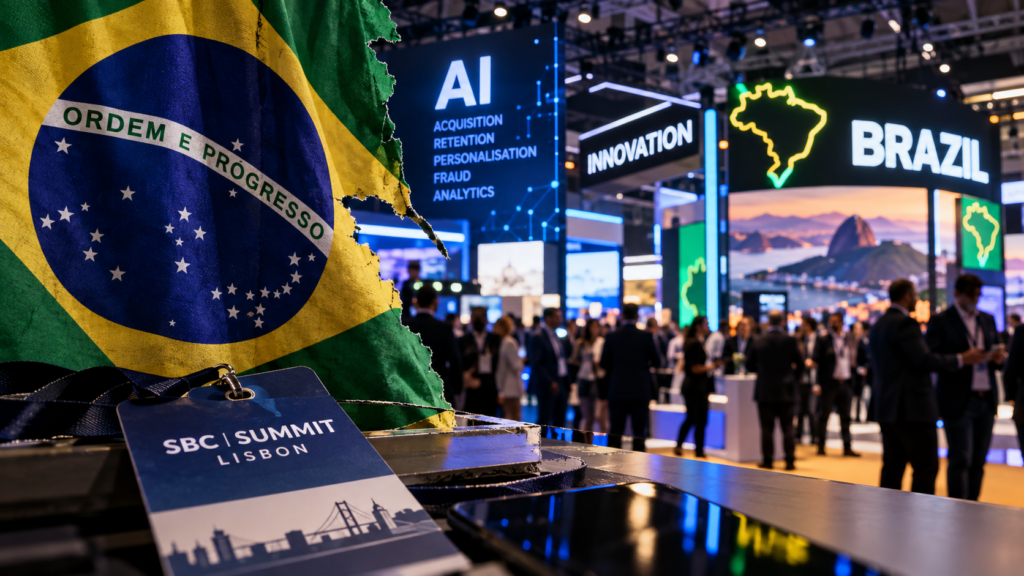
By the third day of SBC Summit in Lisbon, a few themes have become impossible to miss.
AI is everywhere. Every second product seems to be powered by it, enhanced by it or about to be transformed by it. Innovation remains the preferred word for describing almost anything launched in the last six months. And Brazil has taken over a large part of the conversation for a rather more serious reason.
The Brazilian market, which only really settled into its regulated form at the beginning of 2025, has just been thrown into chaos.
On 25 September, President Luiz Inácio Lula da Silva issued a provisional measure banning online betting and gaming. New deposits were stopped immediately, and operators have been told that betting websites and apps must shut down from 6 October unless the measure is overturned or Congress changes course. The order needs congressional approval within 120 days to remain in force, but for operators the practical problem is rather more immediate. Reuters
That happened four days before SBC opened.
So, unsurprisingly, Brazil is everywhere in Lisbon.
People who arrived expecting to discuss customer acquisition, market share, payments and growth are now discussing exposure, legal challenges, shutdown procedures, sponsorship contracts and what happens next.
For an industry conference, it is quite a useful reminder that the most important development of the week sometimes has nothing whatsoever to do with anything being displayed on a stand.
Brazil changes the conversation
Until last week, Brazil was one of the great prizes in global online gaming.
Large population, enormous sporting culture, huge digital audience and finally a regulated framework that allowed serious international operators to commit money with some confidence.
They did exactly that.
Flutter, Entain and others invested heavily in the market, while suppliers, payment providers, affiliates and technology companies followed them in. Brazil rapidly became one of those markets that appeared on every growth presentation.
Now the same companies are working out what happens if the market simply disappears.
Flutter has estimated a possible $70 million hit to 2026 revenue if the ban remains in place. Entain has also warned about the impact on its results, while Allwyn withdrew profit-margin guidance because of the uncertainty. Reuters
Brazilian football is deeply involved as well.
Betting companies generated around R$1 billion in sponsorship revenue for Brazilian clubs in 2025, around 10% of their recurring income, according to Reuters. Clubs are now warning that the loss of that money could affect wages, investment and player sales, and they have joined the industry effort to challenge the measure. Reuters
There are also broader political arguments around the decision. Lula has defended the measure on social and economic grounds, particularly household indebtedness and the effects of online betting on lower-income families. Critics, including political opponents and gaming companies, have questioned both the timing and the use of a provisional measure immediately before Brazil’s presidential election. Reuters
The merits of those arguments will be fought out in Brazil.
Here in Lisbon, people are dealing with the consequences.
And they are considerable.
Brazil was supposed to be one of the markets everybody wanted to enter.
At SBC this week, the much more common question is what exactly everyone is supposed to do now that they are already there.
Meanwhile, back on the exhibition floor
None of this has stopped the rest of the industry from carrying on.
There are still around 800 exhibitors here, and they still have products to sell.
The current favourite is AI.
There has probably never been a technology adopted quite so quickly by marketing departments.
CRM is AI-powered.
Customer service is AI-powered.
Fraud prevention is AI-powered.
Player protection, retention, acquisition, content, trading, analytics and personalisation all have AI attached somewhere.
Some of it is genuinely interesting.
Some of it looks remarkably similar to what the same company was selling last year, although the booth graphic has improved considerably.
This is normal.
Gaming has always gone through vocabulary cycles.
There was a period when everything had to be omnichannel. Then it became seamless. Blockchain had its turn, followed by Web3, personalisation and several variations of next-generation technology.
None of these ideas was necessarily wrong. The problem comes when the terminology starts doing more work than the product.
The easiest way around that is to ask what the thing actually does.
If a system helps an operator make more money, waste less of it, reduce fraud, keep customers longer, improve service or remove some tedious manual process, then there is probably a decent conversation to have.
After that comes the part that tends to get less space in the presentation: how difficult it is to integrate, how much it costs, what has to change internally and whether the people who are supposed to use it will still be using it a year later.
I have seen more than enough casino systems capable of producing extraordinary amounts of information, only for management to export everything into Excel and carry on exactly as before.
Technology has improved enormously.
Human behaviour remains reassuringly consistent.
Where AI does make sense
There are areas where the argument for AI is fairly straightforward.
Customer service is an obvious one. If an operator receives hundreds of thousands of repetitive queries, there is no particular reason for a human being to answer every basic question individually.
Fraud detection makes sense as well. The quantity of transaction data available to large operators is far beyond what any team can examine manually.
The same applies to player behaviour.
Most established operators do not suffer from a shortage of data. They suffer from having more data than anyone can reasonably process.
A genuinely useful system identifies the things somebody ought to care about.
A valuable customer starts behaving differently.
Another is showing signs of leaving.
A promotion is generating very little return.
A transaction pattern looks suspicious.
A group of players suddenly changes behaviour.
A customer appears to be developing harmful gambling patterns.
That is information somebody can act on.
It is a much stronger proposition than simply producing another dashboard.
The customer remains largely indifferent
There is a slightly uncomfortable truth behind most technology exhibitions.
The customer does not care.
They don’t care what CRM system the operator uses, which platform sits behind the sportsbook or how sophisticated the architecture is.
They care whether registration works.
They care whether payments work.
They care whether they can find the product they want.
They care whether withdrawals happen without turning into a correspondence course.
And when something goes wrong, they care whether somebody fixes it.
Everything else is behind the curtain.
In many cases, the best technology is the technology the customer never sees.
The offer becomes more relevant.
The payment is quicker.
Customer service answers faster.
The app works properly.
The operator notices a problem before the customer has to complain.
There is nothing particularly glamorous about any of that, but there is a business in it.
Quite a large one.
Innovation without software
Something else becomes obvious after spending a few days walking around an exhibition dominated by technology companies.
Innovation does not necessarily involve technology.
A better loyalty structure can make more difference than a new platform.
A sensible change to the customer journey can be worth more than an expensive analytics tool.
A better management report can be more useful than another hundred data points.
Sometimes the clever thing is simply changing a process that no longer makes sense.
The technology industry understandably prefers problems that require technology.
Operations tend to be rather less tidy.
Quite often the system is capable of doing what is needed. The organisation simply does not use it properly.
Someone has to change a habit, alter a KPI, move responsibility between departments or stop doing something because “we have always done it this way.”
That is where many projects become difficult.
Installing software is the easy bit.
Getting people to behave differently on Monday morning tends to take longer.
Brazil is the more useful lesson this week
For all the AI discussion, Brazil may end up being the most important subject at SBC 2026.
A regulated market attracted operators, suppliers and investment. Businesses committed capital because they believed they understood the rules.
Less than two years later, those rules have changed dramatically.
Whatever happens legally and politically over the coming weeks, the episode will be studied well beyond Brazil.
Gaming companies spend enormous amounts of time evaluating market size, product, customer acquisition, payments and competitors. Regulatory risk is harder to model because it is frequently political, and politics does not always behave conveniently for spreadsheets.
Brazil has just provided a fairly spectacular demonstration.
It also explains why the conversation around the market in Lisbon feels so different from the normal conference excitement around a new jurisdiction.
There are people here with real money at risk.
There are companies that built teams and strategies around Brazil.
There are football clubs that planned budgets around betting sponsorship.
There are suppliers whose customers may suddenly stop operating.
And there are investors trying to work out whether any of the assumptions they made six months ago are still valid.
That is rather more consequential than the latest product launch.
One more night
SBC finishes tonight with Tiësto at the MEO Arena.
It has been quite a week.
Michael Jordan opened the conference. The Script played the opening party. Hundreds of companies have demonstrated products, thousands of meetings have taken place and enough coffee has been consumed to support a small economy.
Tomorrow the stands start disappearing and everybody goes home.
Then we find out what was actually important.
Some of the technology shown here will be bought.
Some will become standard practice.
Some of the AI products will turn out to be genuinely excellent.
Others will probably return next year with a different description.
Brazil, meanwhile, will still be there on Monday morning.
And a lot of people who came to Lisbon planning their next move in one of the world’s most promising gaming markets will be waiting to find out whether they still have a market to move in.
https://sbcevents.com/sbc-summit/event-schedule/