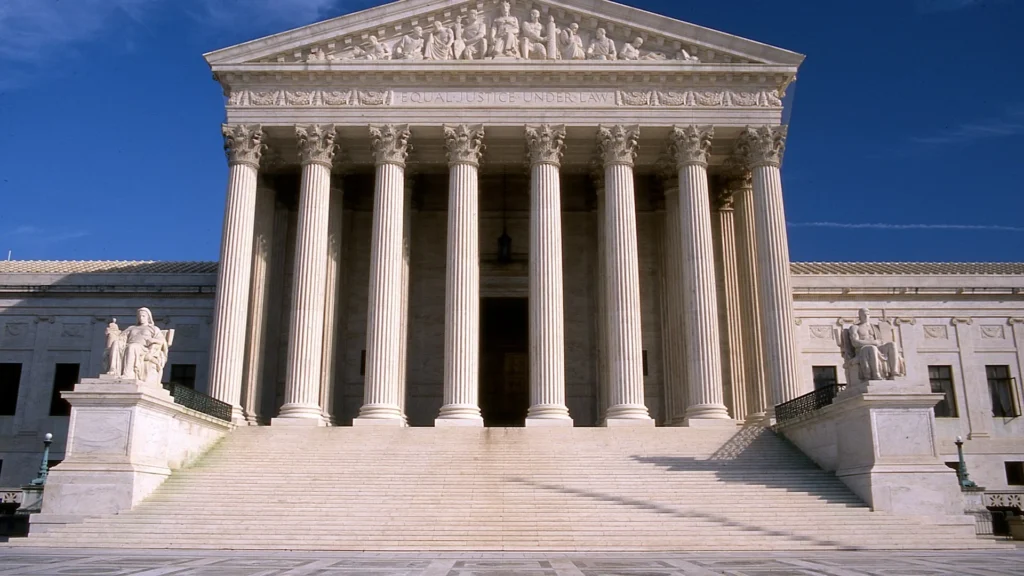
The National Football League urged the U.S. Supreme Court on October 8, 2026, to clarify whether state officials can regulate prediction markets, arguing states are better equipped than the federal government to police them. The filing puts the league into a jurisdictional dispute with consequences for how sports-linked contracts are treated alongside established sports betting.
The dispute over sports-linked markets
At issue is who should oversee platforms where customers trade contracts tied to the outcome of events, including sporting events. The NFL’s position, as described in the filing report, is that state officials should have authority to regulate these increasingly popular markets because states are better placed to police them.
That question sits at the boundary between state gambling oversight and federal regulation of financial markets. The Commodity Futures Trading Commission (CFTC), the federal derivatives regulator, is central to the dispute; however, the available primary-source extract does not set out the NFL’s full legal arguments or the commission’s response. Prediction markets and sports betting therefore remain overlapping regulatory categories in this account, rather than interchangeable terms.
The request follows New Jersey’s effort to bring the dispute before the Supreme Court. The state’s petition sought review of whether sports-related prediction contracts can be subject to state gambling laws, a question tied to conflicting federal appellate decisions. The NFL’s move adds the league to a case that could determine how much room states retain to regulate markets connected to games.
The New Jersey petition to the Supreme Court reflects the same core uncertainty: whether federal oversight displaces state gambling authority when contracts are linked to sports outcomes. Separately, the CFTC’s approach to prediction-market rules forms part of the wider regulatory backdrop.
Federal oversight and state authority
Kalshi, a leading prediction-market operator involved in the wider litigation, has argued that these products belong under federal oversight as financial instruments, rather than being governed exclusively by state gambling laws, according to reporting by ESPN and CNBC. The CFTC has also asserted a role in overseeing derivatives and event contracts. Those positions frame the opposing view to the NFL’s preference for state-level policing, but the primary-source extract does not provide a full response from either Kalshi or the commission to this filing.
The distinction matters commercially as well as legally. A federal framework could give operators a more uniform set of rules across jurisdictions, while state oversight would connect sports-linked markets more directly to the local licensing and consumer-protection systems that govern gambling. Neither approach is described here as settled law: the case concerns where authority lies, not a final determination that every prediction contract is legally the same as a conventional sports wager.
The NFL has previously raised concerns with federal rulemaking on sports contracts. Its position in this Supreme Court dispute continues that push for a regulatory approach it considers better equipped to address risks in sports-linked markets. The league’s earlier objections to federal rulemaking for prediction-market sports contracts provide additional context for its preference for state authority.
A test of the regulatory boundary
The matter is identified in the primary report as Flaherty v. KalshiEX Companies. Supplementary reporting describes a split among federal appeals courts over whether states can enforce gambling laws against sports-related prediction markets, with New Jersey seeking Supreme Court review in September. That conflict has sharpened the need for a clear answer on the relationship between state gambling laws and federal derivatives oversight.
The NFL was represented by former U.S. Attorney General William Barr and other attorneys from Torridon Law. The league’s argument is that states are better equipped than the federal government to police prediction markets, putting its institutional weight behind state authority as the court is asked to consider the dispute.
The post NFL Puts State Authority at Heart of Prediction Markets Case appeared first on CasinoBeats.