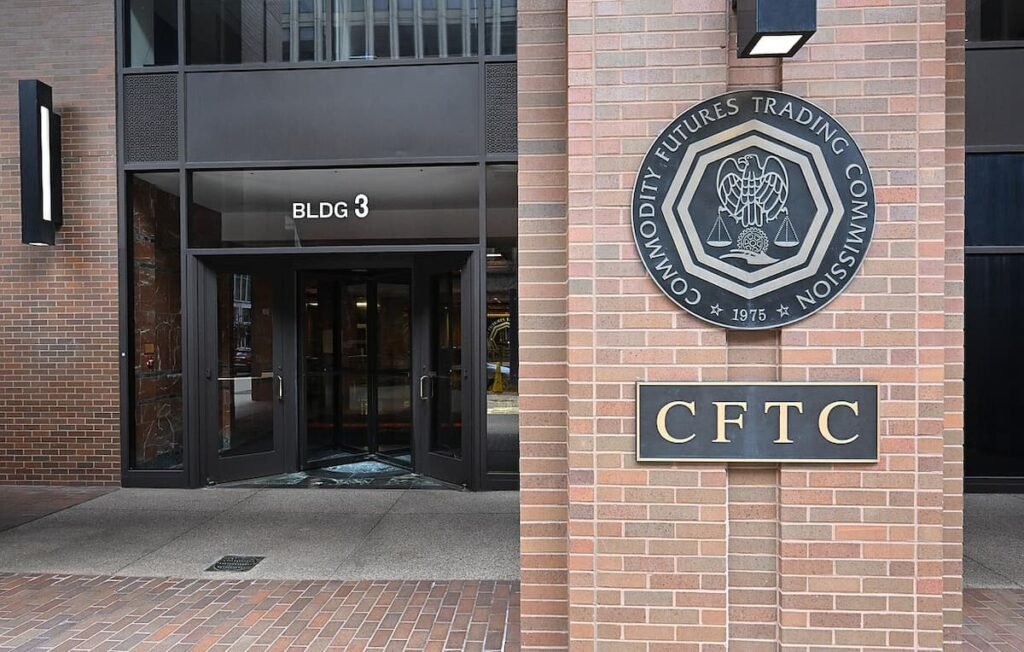
The federal government has escalated the prediction market battle, suing three states and setting up a direct clash over who controls the emerging sector.
The Commodity Futures Trading Commission (CFTC) has stepped directly into the prediction market dispute, filing lawsuits against Arizona, Connecticut, and Illinois, in what it describes as an intrusion on its “exclusive jurisdiction” over futures, options, and swaps traded on federally regulated exchanges.
The lawsuits mark a shift in the legal fight from operator-led challenges into a full federal-state confrontation.
CFTC’s Core Argument: Federal Authority Over Event Contracts
The lawsuits are a result of cease-and-desist letters issued by the three states to operators such as Kalshi. Arizona escalated further, bringing criminal charges against Kalshi.
At their core, the complaints argue that state regulators are attempting to control markets that fall under federal jurisdiction. They rely on the Commodity Exchange Act (CEA), which gives the CFTC primary authority over derivatives markets.
In the Illinois filing, the CFTC states:
Illinois’s attempt to shut down federally regulated DCMs intrudes on the exclusive federal scheme Congress designed to oversee national swaps markets.”
“This federal law designates the CFTC as the federal agency with ‘exclusive jurisdiction’ over the regulation of futures, options, and swaps traded on federally regulated exchanges.”
They characterize prediction market products accordingly:
Event contracts are derivative instruments that enable parties to trade on their predictions about whether a future event … will occur.”
From that premise, the government argues that state-level gambling laws cannot apply:
The CEA prohibits States from invading the CFTC’s exclusive jurisdiction over event contract transactions offered by and executed on federally regulated DCMs.”
The Core Legal Question: Swaps or Gambling?
One of the central arguments in the dispute is classification.
The federal government’s position is structural. If a product is designed and listed as a derivatives contract, it falls under federal law regardless of the underlying event — whether economic, political, or sports-related.
State regulators, however, have argued that certain contracts, particularly those tied to sporting events, do not fall under CEA’s definition of “swaps.” They claim that if users are effectively wagering on outcomes, the contracts depend on the outcome of sporting events, not the type of “occurrence”-based event contemplated under the CEA.
This divide has already surfaced in ongoing litigation across multiple jurisdictions. There is a split among federal courts, including a split in the Sixth Circuit. There, a Tennessee judge ruled that sports event contracts are likely swaps. Meanwhile, an Ohio judge ruled they are likely not.
Elsewhere, courts have questioned whether a game outcome qualifies as a valid “event” under the CEA, while others (including in Maryland) have avoided ruling directly on the issue.
State courts, including in Massachusetts and Nevada, have mostly sided with state regulators.
That tension reflects a broader issue: event contracts can simultaneously serve as both financial hedging tools and betting products, depending on their use.
Two key rulings are expected today. First, a federal judge in Arizona will rule on both Kalshi’s request for a preliminary injunction against the state and whether the federal court should even hear the case, given the state’s criminal proceedings.
Then, in Nevada, a state court will rule on the state’s request for a permanent injunction against Kalshi, following an earlier temporary restraining order.
The Other Question: Federal Preemption
Another key argument raised by the CFTC lawsuits is that federal law preempts state authority altogether. But that argument is not settled.
Courts have not consistently ruled on how far the federal authority extends. The key issue is congressional intent: whether lawmakers intended for federal derivatives law to displace state gambling regulation in cases like sports-event contracts.
As with the swaps question, courts remain divided. In the Sixth Circuit, a Tennessee court found federal law likely preempts state gaming regulation, while an Ohio court reached the opposite conclusion.
Elsewhere, federal courts in Maryland and Nevada have also ruled that federal law likely does not preempt state regulations.
In March, a federal judge sent Nevada’s enforcement action against Kalshi back to state court, rejecting the company’s arguments for federal jurisdiction. The court explained that for federal law to “completely preempt” state law, Congress must clearly show that it intended to replace state claims with an exclusive federal system, which it did not find in the CEA.
The judge pointed to a CEA “savings clause,” indicating Congress did not clearly intend to eliminate state authority simply because the CFTC regulates certain markets.
A Shift in Federal Posture
The lawsuits also reflect a broader change in the CFTC’s approach under Chair Michael Selig.
Rather than limiting its involvement to rulemaking or amicus briefs, the agency is now actively seeking to block state enforcement in federal court.
In February, first in a Wall Street Journal op-ed and then on social media, Selig announced that the agency will no longer sit on the sidelines and will instead escalate its direct defense of federal jurisdiction over prediction markets. He added that the CFTC would back Crypto.com in its Nevada litigation.
In the press release announcing the lawsuits, Selig said:
The CFTC will continue to safeguard its exclusive regulatory authority over these markets and defend market participants against overzealous state regulators.”
“This is not the first time states have tried to impose inconsistent and contrary obligations on market participants, but Congress specifically rejected such a fragmented patchwork of state regulations because it resulted in poorer consumer protection and increased risk of fraud and manipulation.”
What Comes Next
Courts are unlikely to resolve the cases quickly. Legal observers have noted that the lawsuits target states with Democratic governors and attorneys general, suggesting additional cases could emerge.
The complaints raise questions about federal preemption, congressional intent, and the scope of derivatives regulation. At stake is not just market access, but whether prediction markets are financial instruments or gambling products.
Given the constitutional dimension of the dispute, the cases are widely expected to continue through appellate courts. There’s a strong possibility of reaching the Supreme Court eventually.
Image credit: G. Edward Johnson via Wikimedia Commons (license)
The post Federal Government Sues Illinois, Connecticut, Arizona Over Prediction Markets Regulation appeared first on Gambling Insider.