Wynn Resorts CEO Craig Billings had a busy slate of topics to address during the company’s first-quarter earnings call on Thursday – both good and bad – as the company posted strong results across Las Vegas and Macau.
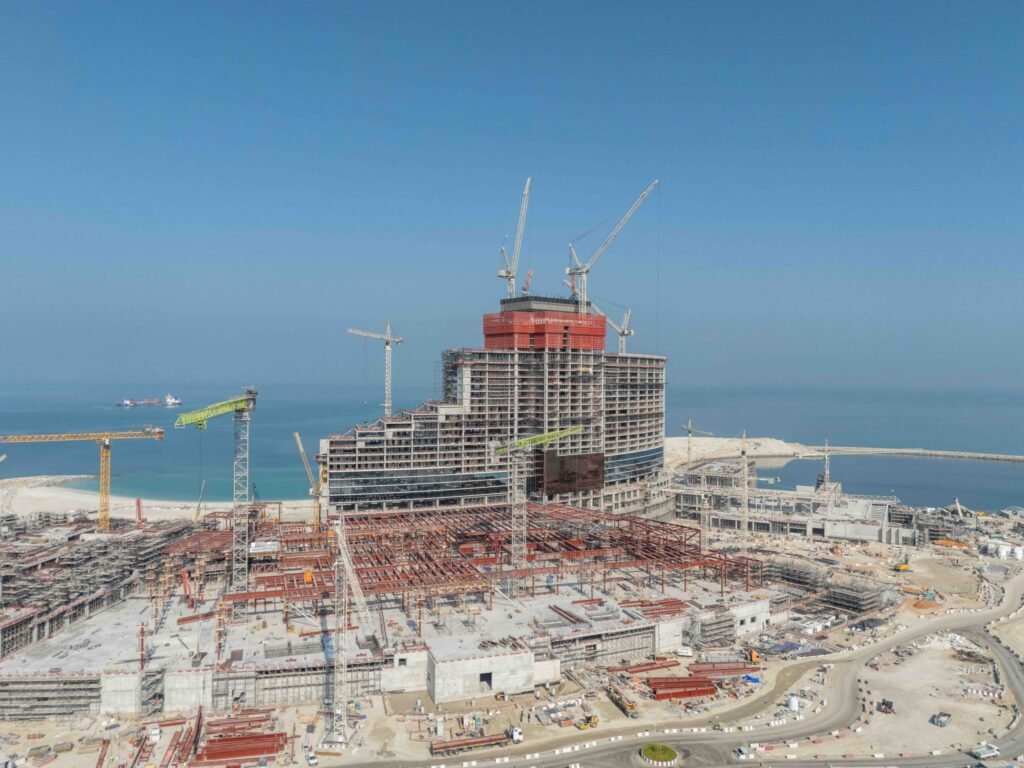
The biggest question on everyone’s minds had nothing to do with earnings and everything to do with the Middle East. The US-Israeli war with Iran that kicked off on 28 February and entered a ceasefire on 8 April has impacted the status of the much-hyped Wynn Al Marjan integrated resort in the United Arab Emirates.
In his first comments since the conflict began, Billings confirmed Wynn is expecting a “modest delay” in the opening of the $5.1 billion integrated resort, but declined to quantify that further. The casino was originally slated to open in March 2027 but Billings used 2027 generally in his remarks. While he acknowledged the factors outside the company’s control, he lauded the UAE’s security response and downplayed long-term risks for the project.
“I mentioned that we expect a modest delay, and I use the word modest very intentionally, because that’s what we believe it will be,” Billings told analysts. “We don’t want to size that until we have a real view on stability.”
Wynn’s Q1 group revenue was $1.86 billion, a 9% jump year-over-year, with net income almost doubling from $72 million to $120.5 million this year. Wynn’s adjusted property EBITDAR came in at $562.4 million, representing a modest 5% gain over last year. During the quarter just past, Wynn contributed $100 million towards Al Marjan, bringing its total contributions to $1 billion.
Long-term impacts for the UAE?
The short-term effects of the Iran conflict such as higher energy prices and a reduction in international travel could form into longer-term doubts about the business prospects of the region as the conflict remains unresolved. Billings assured analysts that life in the emirates is going along as normally as possible, but there have been lasting impacts.
The UAE announced on 28 April it is exiting the Organization of the Petroleum Exporting Countries (OPEC), a significant development for a 60-year-old coalition that has a big influence over energy markets. As evidenced by the Wynn project and the growth of Dubai and Abu Dhabi as travel hubs, the emirates’ economy has diversified, to the extent that such an exit feels warranted.
“This is a decision about far more than production quotas or wartime disruptions. It reflects structural changes in global energy markets, fundamental shifts in the world economy, and a clear-eyed view of where the UAE stands – and where it is going,” Yousef Al Otaiba, the UAE’s ambassador to the US, wrote in the Financial Times.
The reality of the Iran conflict and its tentacles, however, has shown reasons for concern. Emirati officials have approached the US about a potential currency swap line, and its defence systems are grappling with Iranian attacks amid a fragile ceasefire. As of early March, the US State Department placed the UAE under a Level 3 travel advisory, meaning Americans should “reconsider travel” due to conflict risks. Still, Billings said on Thursday that Wynn embarked on Al Marjan knowing there was some level of uncertainty.
“When we underwrote this project, we didn’t underwrite a region with zero geopolitical risk – we underwrote a country with a demonstrated ability to manage through it and emerge in a better competitive position on the other side,” Billings said.
The Enclave coming to Cotai
Once the UAE update was complete, Billings and company moved on to a much more positive announcement, a new all-suite hotel tower at Wynn Palace in Cotai called The Enclave.
With an estimated cost of $900-$950 million, the 432-suite tower will expand the property’s room count by 25% and its suite count by 50%. Construction will begin sometime in 2016 and is slated to run for about two and a half years. The tower won’t have a gaming component and only sparse amenities but is nonetheless expected to drive considerable value in the market.
“When you’re at 99% occupancy, you’re not making a speculative bet by adding rooms, you’re clearly capturing demand that already exists and that you’re currently turning away,” Billings said. He added that it’s “reasonable to assume” the tower could drive $400 million in incremental GGR.
Wynn’s Macau segment posted overall adjusted EBITDAR of $279.5 million, a 10% increase year-over-year, and operating income jumped 14% to $145.2 million. Wynn Palace specifically had a standout quarter, with its casino revenue and adjusted EBITDAR both growing by more than 25% YoY.
Wynn continues Las Vegas strength
In contrast to its contemporaries MGM and Caesars, there was little concern from analysts on Thursday over Wynn’s performance in Las Vegas, which has held steadier than its peers for several quarters due to the company’s specialty with wealthy clientele. After a tough 2025, the market overall is on a good pace so far in 2026, with visitation and gaming revenue both trending upward.
Wynn’s Las Vegas revenue grew 6% YoY to $661.9 million in Q1, with adjusted EBITDAR climbing 4% to $232.5 million. RevPAR, or revenue per available room, was $506 for the quarter, a 10% increase, and its average daily rate of $592 was a 12% increase over last year.
In some ways, Wynn is opposite from most in Las Vegas in that it faces tough YoY comps due to its outperformance. The company is also starting a renovation of its Encore tower this year, which will bring some level of disruption, but its overall outlook remains positive.
“Las Vegas is performing incredibly well by all historical standards … everything that we can see looking out further into the year, and based on what we saw in Q1, makes me feel good about 2026,” Billings said. “But I do want to carefully distinguish us from the market in general, because we didn’t see a slowdown in 2025.”
There were no questions this quarter about Wynn’s vacant 38-acre plot on the Strip, which has long been a source of speculation. The company has been largely neutral on the future of the land, which it purchased for $336 million in 2017.
Shares volatile as Fertitta sells call options
Wynn ended Q1 with total cash and equivalents of $1.19 billion, excluding $607.6 million of short-term investments held by Wynn Macau. The company also completed the quarter with total debt of $10.5 billion, including $5.76 billion of Macau related debt, $877.2 million of debt from Wynn Las Vegas. The company repurchased $53.8 million worth of shares in the quarter and has $401 million remaining in repurchase authority.
On that front, Wynn’s biggest shareholder Tilman Fertitta is in takeover talks with Caesars, and has been steadily selling call options on his stake in recent months. Wynn previously told iGB it does not comment on its shareholders, and no questions were asked Thursday.
Wynn stock was down about 4% in trading Friday to $102, in what has been a somewhat volatile stretch for investors. Shares are down over 20% in the last six months but up 17% over the last year. Macquarie analyst Chad Beynon rated Wynn as an “outperform” on Friday while also lowering the target price to $150, down from $152.
“While UAE timing uncertainty remains the principal near-term debate, we believe the market is underappreciating the durability of Vegas and Macau earnings, and we continue to ascribe $25–$50 per share of long-term equity value to Wynn Al Marjan Island,” Beynon wrote.
“Further, we believe WYNN shares are trading more in line with broader consumer discretionary names, despite several structural tailwinds: (1) MSD+ Macau growth driven by premium mass; (2) continued Las Vegas outperformance supported by luxury pricing power; (3) a meaningful long-dated inflection from Al Marjan; and (4) a capital-friendly allocation strategy supported by strong liquidity.”
Polymarket, a leading prediction market, listed more than a dozen event contracts on the Iran conflict on Friday evening. As of 5 p.m ET, one contract ascribed a 74% probability of a permanent peace deal between US and Iran by 31 December.

Jess Marquez
Jess has covered the global gaming industry since 2022. A native of Reno, Nevada, he’d like to note that it’s Ne-va-da, not Ne-VAH-da.