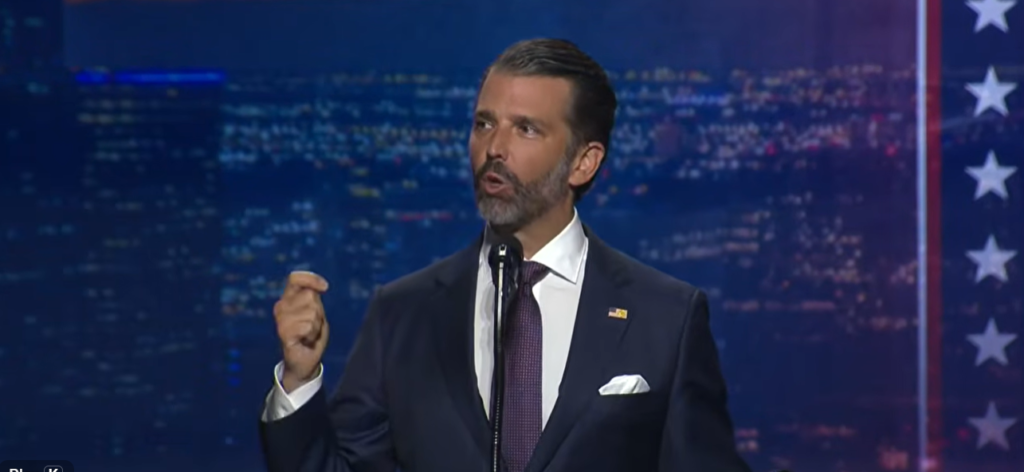
In the wake of a Democratic Blue sweep in the US midterm elections, Donald Trump Jr. has severed ties with Kalshi.
Trump Jr., the son of US President Donald Trump, initially received an equity stake in the prediction market-operator in January 2025, months after his father defeated Democratic challenger Kamala Harris. The victory by Trump secured his return to the White House after a bitter defeat four years earlier. The 2024 election served as an inflection point for event contracts on politics as several traders placed seven-figure transactions on Trump just before Midnight on Election Night.
Shortly thereafter, Trump Jr. joined the advisory board of Kalshi rival Polymarket when his venture capital fund 1789 Capital made an initial strategic investment in the company.
Talks between Kalshi and Trump Jr. on a potential exit gained momentum over the summer when 1789 Capital increased its investment into Polymarket. In August, the firm led a $1 billion funding round when it invested $300 million in the company, on top of an initial investment of $200 million. Trump Jr., 48, reportedly received a $300,000 equity stake in Kalshi last year. Kalshi’s valuation has grown exponentially since, rising to approximately $40 billion based on a recent funding round.
“We have mutually agreed to Don’s advisory role after his firm’s significant investment in a competitor this summer,” Kalshi wrote in a statement to Bloomberg. “We are grateful for his contributions in helping market Kalshi to more customers.”
More funding?
Weeks after Kalshi completed a $1 billion funding round for a $40 billion valuation, reports surfaced Thursday that the company is seeking additional funding. According to multiple reports on Thursday afternoon, Kalshi is in discussion with investors to raise another $1 billion in a funding round that would value the company at $65 billion.
If completed, the valuation would represent a 62.5% increase from Kalshi’s previous valuation in October. In May, Kalshi received a $22 billion valuation after it secured $1 billion in funding from a round led by Coatue. Over the last two years, Kalshi has completed a meteoric rise, fueled by private investments. When Trump defeated Harris in November 2024, Kalshi’s valuation remained south of $2 billion.
As prediction markets continually become integrated into daily life, both companies have been subjected to intense speculation on an eventual IPO. However, another funding round into Kalshi so quickly could suggest that the company has pivoted back to private markets.
Both Kalshi and Polymarket accurately predicted a Democratic sweep hours before booths closed on Election Night. Victories by the Democrats in the Senate and the House of Representative marked the first time that the party controlled both chambers since 2023.
Circuit split
Top prediction market operators are awaiting a potential showdown in the US Supreme Court on the legality of sports event contracts. Kalshi won a key decision in April when the U.S. Court of Appeals for the Third Circuit ruled that sports event contracts are swaps under the Commodity Exchange Act. But in August, the Ninth Circuit took an opposing stance when it ruled that the contracts are not protected as swaps under the CEA. Typically, “circuit splits,” on major legal issues can prompt the Supreme Court to hear the relevant case.
Prediction market backers claim that the federal government has exclusive jurisdiction over regulation of the derivatives, while proponents of states rights claim that the options violate state laws on sports betting.
Last week, the Ninth Circuit denied Kalshi’s petition for rehearing on the legality of sports-event contracts, classified as “swaps. The denial opens a 90-day window for Kalshi to seek review from SCOTUS, according to gaming attorney Daniel Wallach.
On Friday morning, Trump Jr. had odds of 0.5% to win the 2028 US Presidential election. At those odds, a user who places $100 on the “yes” option would win $18,697.71.