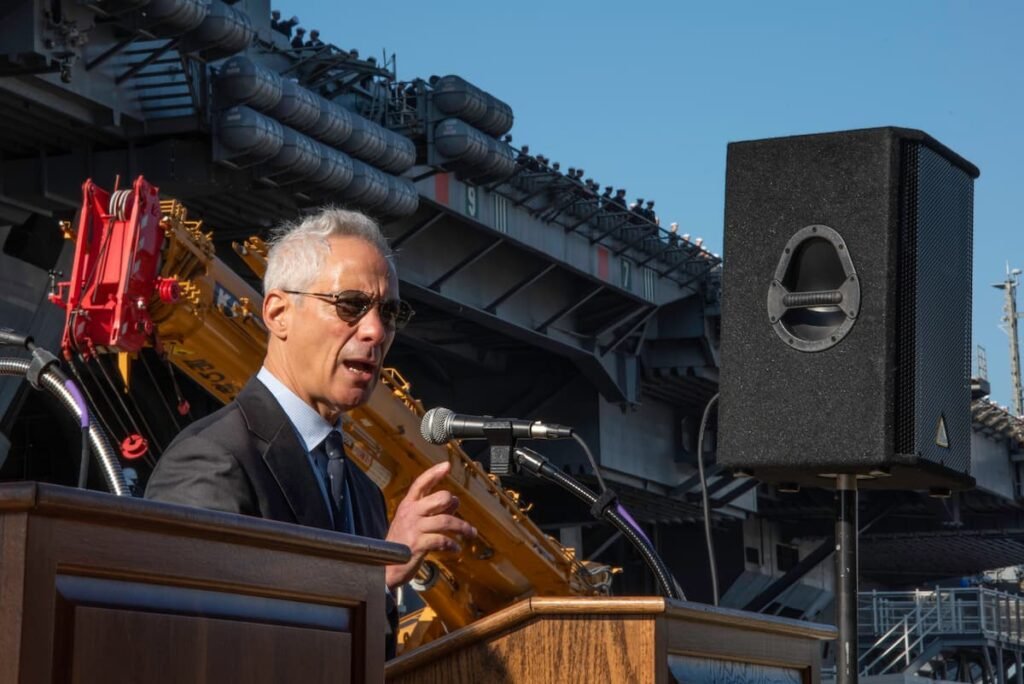
Former Chicago Mayor Rahm Emanuel is pitching a 10% federal levy on all types of online gambling, including prediction markets.
Former Chicago Mayor and U.S. Ambassador to Japan, Rahm Emanuel, has unveiled a proposal to impose a 10% federal tax on online gambling and prediction markets, aiming to generate up to $50 billion annually to fund U.S. innovation and strengthen its global competitiveness.
He estimates this would generate between $30 billion and $50 billion annually, which could then fund a new American Innovation Fund focused on research in fields such as AI, fusion energy, national security technology, and quantum computing.
The prospective 2028 presidential candidate says the end goal is to ensure that the U.S. stays ahead of China.
Emanuel would need Congress to pass an act for his proposal to become law. That could present as a significant hurdle, especially in the current political environment.
2028 Positioning Takes Shape
Emanuel has reentered public life with various policy pitches since his time as U.S. ambassador to Japan ended in January 2025. Experts believe he is trying to create a narrative ahead of what is set to be a competitive race for the Democratic nomination in 2028.
California Gov. Gavin Newsom is currently the favorite to win the nomination for the Democratic Party.
Emanuel expanded on the details of his online gambling levy while speaking at a Wall Street Journal Live event on Wednesday in Washington, D.C.
He also proposed a $25,000 tax credit for first-time homebuyers. Emanuel further suggested reorienting the federal housing agencies, Freddie Mac and Fannie Mae, to help people buy their first homes. He also wants the federal government to raise the mandatory retirement age from 67 to 75.
When asked this week whether he unveiled these policy ideas to stand out from Democratic rivals, Emanuel noted that it could be a “side benefit.” Still, he said that he is “more interested in the American people getting ahead and America staying ahead.” The 66-year-old confirmed that he is considering running.
Taxing Gambling to Fund Innovation
Emanuel’s proposal follows a familiar political playbook: taxing a vice, such as gambling, to fund a widely supported public good. The framing helps blunt political resistance by directing revenue toward broadly appealing national investment goals.
Emanuel compared his proposal to other vice tax concepts, such as alcohol and tobacco. He said he is confident that other Democrats would support increased spending on research funding.
He argued that the Trump administration cut research institutions deeply and showed hostility towards universities, which he believes benefits China.
Emanuel is positioning himself as the candidate who will take the China threat seriously. He has long promoted ideas focused on competitiveness and economic growth rather than on social justice.
Industry Opposition Likely
If Emanuel’s proposal gains traction, a well-financed and politically connected opposition will challenge it. According to reports, the global online gaming industry generated $121 billion in 2025, and projections show it will exceed $123 billion this year.
The U.S. legal sports betting sector has grown significantly since the end of the federal ban in 2018. The market has grown from approximately $2.5 billion in 2018 to almost $20 billion five years later, and projections show it will reach $40 billion by 2029.
Emanuel estimates that the online gambling and prediction market industry handles about $400 billion in total wagering, not just revenue.
The legal gaming industry has the resources and motivation to strongly lobby against a 10% cut into its business. Bipartisan state legislators, tribal gaming operators, and professional sports leagues that have embraced legalized online gambling would likely join that opposition.
Previous Federal Efforts Have Stalled
Emanuel is not the first politician to try to leverage the online gambling industry. Rep. Paul Tonko spent several years trying to introduce legislation aimed at curbing what he described as predatory advertising practices in the online gambling industry.
He introduced the Betting on Our Future Act in February 2023, which would have banned all online marketing for sportsbooks. He modeled the bill on legislation that banned tobacco advertising. However, it failed to gain traction on Capitol Hill. It had zero co-sponsors, and critics argued that sports betting advertising is constitutionally protected under the First Amendment.
Tonko returned in 2024 with a more expansive piece of legislation called the SAFE Bet Act, co-sponsored in the Senate by Richard Blumenthal. He scaled back from proposing a full advertising ban and instead called for restrictions on gambling ads during primetime hours or live sporting events.
He suggested limits on promotional language and how operators use AI to target users. The SAFE Bet Act also proposed creating a federal framework for sports betting regulation, including a national self-exclusion register.
The SAFE Act has stalled so far despite Tonko’s efforts to build support, which included sending letters to major sports league commissioners to gain their backing.
Prediction Markets Raise National Security Concerns
Emanuel presented the 10% federal levy as part of a broader policy approach to online gambling and prediction markets. Last month, he called for a full ban on federal employees and their families betting on prediction markets, amid growing bipartisan concern over potential insider trading and misuse of non-public information.
He included the judicial, legislative, and executive branches in that proposal. He cited concerns about people with access to sensitive national security information allegedly profiting by placing bets on U.S. military actions in Venezuela and Iran.
Together, the proposals underscore Emanuel’s view that unchecked growth in online gambling and speculative markets presents both a governance challenge and a national security risk, extending beyond traditional public health concerns. Whether such measures can gain traction in Congress remains uncertain.
The post Rahm Emanuel Targets Online Gambling With $50 Billion Tax Plan to Counter China Threat appeared first on Gambling Insider.