Europe is perhaps going through the most dynamic period of regulatory changes the gambling sector has seen in recent years.
In times like these, dialogue must take utmost priority to ensure fair market conditions remain the standard, and that competition is encouraged rather than stifled.
The Balkan Gaming Federation (BGF) was set up with this goal in mind, facilitating an active conversation where the licensed gambling sector is given an active voice and more levers to build a cohesive defense against damaging policies and the proliferation of illegal gambling.
SBC News sat down with Milen Totev, Chairman of The Association of Organisers of Gambling Games and Activities in Bulgaria (AOGGAB), to unveil more about the BGF’s role and how it fits within the wider European context.
1. What led to the creation of this federation and what is the role of AOGGAB in it?
The Balkan Gaming Federation was established because the legal gaming industry in the Balkans needs better coordination, faster exchange of information and a stronger regional voice.
In recent years, similar problems have emerged in different countries in the region: frequent legislative changes, additional pressure on licensed operators, new tax ideas, restrictions on advertising and a serious risk of expanding the illegal market. When these processes are happening in parallel in several countries, national associations need to work more cohesively.
AOGGAB was one of the initiators of this process together with the Serbian association AGOS. The idea developed after discussions between colleagues from different Balkan countries, where it became clear that we need a permanent working format, not just meetings during international events.
The role of AOGGAB is active because the Bulgarian association has organisational experience, a strong membership base and a clear position on key topics for the legal industry.
The goal of BGF is to help create a better business environment between countries, for more predictability for investors and for the exchange of good practices. If a mistake has already been made in regulation in one country, other markets should be able to see it in time and not repeat it.
Together with colleagues from BGF, we have already prepared a communication strategy and specific initiatives with which to fulfill our goals: fighting the illegal market, protecting legal business, promoting responsible gaming, better exchange of information and a stronger representation of the Balkans in the European conversation.
We have already released the first positions of the Federation on important topics in the region.
On May 26, the next working meeting is scheduled in Belgrade, where the statute of the Federation will be voted on. The first president of the BGF is expected to be elected in September.
2. What role do you foresee the Balkan Gaming Federation playing in the fight against the black market?
Fighting the black market is one of the main tasks of the BGF. Illegal gambling does not stop at national borders. Especially in the online environment, illegal operators reach users in different countries, without paying taxes, without respecting responsible gaming rules and without protecting the user.
BGF will work for faster exchange of information between associations, common initiatives against the illegal market and better relations with institutions in each country.
Legal operators are a natural partner in this process. Every operator who has a license, pays its taxes and complies with the rules has an interest in illegal sites being identified and reported. This is not only business protection, but also consumer and state interest protection.
In this context, the example of the Croatian association HUPIS, which has developed a platform for reporting illegal websites, is important. The BGF is already working to implement this tool in all Balkan countries. The aim is to report illegal websites faster, in a more structured way and in real time, so that institutions have more accurate information.
3. To what extent will the decisions and actions of BGF be independent of EUROMAT?
BGF will complement EUROMAT, promote the organisation in the region and work for its expansion in the Balkans. The Federation is not an alternative to EUROMAT. It is a regional mechanism that will better connect Balkan associations with the European context.
Countries whose associations are not yet members of EUROMAT also participate in BGF. This creates an opportunity for EUROMAT to become more recognizable and better represented in this part of Europe.
EUROMAT has an important role in the European conversation, especially with regard to the land-based sector. At the same time, Balkan associations unite a wider environment: operators, manufacturers, online businesses, technology companies and suppliers. BGF will provide a faster channel for communication between these participants and European structures.
Some of the initiatives will be taken at the regional level by BGF. But the strategic direction is clear: more coordination with EUROMAT, a stronger Balkan presence and better representation of the region in Europe.
4. Where does the Balkan gambling market rank in terms of quality, size and prospects compared to its equivalents in Central and Western Europe?
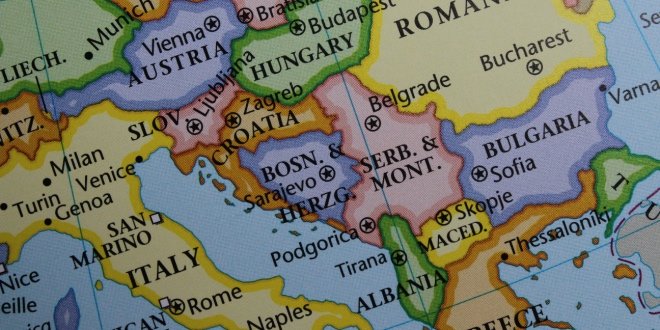
The Balkan market is not the largest in Europe in absolute size, but it is one of the most dynamic and promising regions. Central and Western Europe have more mature markets and a longer regulatory history.
The Balkans have another strength: a high concentration of operators, manufacturers, software companies, payment solutions, technology teams and B2B suppliers, who now work not only locally but also internationally.
Bulgaria is a very good example. The country has become a real hub for the gambling industry, with manufacturers, software companies, online operators, B2B suppliers and international teams. Similar processes are also seen in other Balkan markets, which makes the region increasingly important for Europe.
The Balkans are also significant geographically. The region is at the crossroads of Europe, Asia and the nearby emerging markets around the Mediterranean and the Middle East. This makes it a natural B2B corridor for investments, partnerships, technology and expansion.
The main condition for this potential to develop is predictability. Investors need clear rules, a stable environment and professional talk with institutions.
5. How will the BGF represent the interests of the Balkan industry and what are these interests?
The BGF will represent the interests of companies that operate, produce, invest and create jobs in the Balkans.
These interests are specific: protection of the legal market, fight against illegal operators, stable regulatory environment, reasonable taxation, responsible gaming, consumer protection and predictability for investors.
The Federation has already started to act on these topics. We have sent positions to Romanian institutions in relation to the adopted law, according to which each municipality will issue licenses at the local level, as well as to Montenegrin institutions in relation to the proposal for a 12% tax. These positions show how the BGF will work: timely, concretely and on topics that affect the entire region.
In Montenegro, the problem is that such a tax structure can lead to double taxation and to uncertainty about who actually bears the burden: the operator, the player, or both parties.
When the operator is already taxed, and then the player’s profit is also taxed without a sufficiently clear threshold and logic, this creates pressure on the legal market and makes the conditions more unpredictable. We have also launched the regular Balkan Gaming Brief.
It will provide systematised information about the processes in the Balkans, with an analysis of the direction, the overall picture and the connections between the individual markets.
The aim is for institutions, associations and companies to see not only the individual news, but the full picture. Responsible gaming will also be a leading topic. The legal industry has an interest in the consumer being protected and informed. Gambling should be perceived as a form of entertainment, not as a solution to financial problems.
6. Bosnia and Herzegovina is considering measures to remove the VAT exemption for the gambling sector. In Macedonia, the President wants more bans. Montenegro wants higher taxes. In Bulgaria, there is discussion of raising the minimum age from 18 to 21. Is the sector under pressure from rising populist policies in the Balkans?
Yes, the sector is under pressure from populist policies. This is visible in almost all countries in the region. Gambling is often a convenient political topic because it is a sensitive sector. Restrictions sound easy to the public, but their effect is not always analysed professionally.
When licensed operators are excessively pressed, consumer demand does not disappear. Part of it shifts to the illegal market.
In Bulgaria, for example, there was discussion of raising the minimum age for participation in gambling from 18 to 21 years. This requires careful legal analysis, because in Bulgaria the age of majority is 18. If a different threshold is introduced for a specific legal sector, the arguments must be very clearly defended.
Taxes must also be approached carefully. If a system leads to ambiguity, double burden or additional burden for licensed operators and players, it creates pressure on the legal market and opens up space for illegal ones. The BGF has already shown that it will not be a passive structure. The Federation will take positions on important issues and defend the principle that regulation should be professional, not campaign-based.
7. A Romanian representative in the European Parliament recently proposed a common tax for all online gambling operators. How would you comment?
Such an idea sounds easy politically, but it is very complicated legally and practically.
In the European Union, gambling is regulated in such a way that each member state determines the rules for the sector independently within the framework of its national legislation and in compliance with the general principles of the EU. Therefore, a common tax for all online operators would mean a change in the current logic of the European framework.
If such a measure appears, many questions will arise: who collects it, how is it distributed between the countries, how is the size of each market taken into account, how is an additional burden avoided for licensed operators and how is the illegal online market treated.
Such a change will create chaos and uncertainty not only in Europe. Markets are already connected on a global scale. One operator, one provider or one technology company often operates across several jurisdictions.
If a common fee is introduced without a clear legal and practical framework, the impact will be felt far beyond the online segment itself. Our position is that the European conversation is important, but it must take into account national regimes and the reality of individual markets.
A measure that increases the burden on licensed operators without limiting the illegal market will not solve the underlying problem.
8. How do you read the new political situation in Bulgaria? Do you expect substantial changes in gambling legislation, considering that the new government under Rumen Radev and his Progressive Bulgaria party will implement measures to build a stronger economy?
I expect the gambling sector to remain in the focus of the political conversation.
The topics are already clear: age threshold, advertising, taxes, online control and measures against addictions.
In “Progressive Bulgaria” there is a request for a stronger economy, more predictability and a better business environment. If this is the real direction, the legal gaming industry should be considered as an economic sector, and not just as a sensitive public issue.
In Bulgaria, the industry provides about 30,000 jobs, a large part of which are highly paid and qualified. The sector brings serious revenue to the budget, actively participates in exports through manufacturing, software, technology and B2B services, and creates an environment in which the country positions itself as a regional hub.
We expect legislative initiatives. Our position is that any significant change should be discussed with the industry, the regulator and the experts. If the state wants a stronger economy, it should not treat one legal sector only as a problem. It should be regulated, controlled and included in the economic logic of the country.
9. Separately, one of the political parties in the current parliament has openly stated that it will seek a complete ban on gambling advertisements. How will such a decision affect operators in Bulgaria?
A complete ban on advertising will have a serious effect on the market. First of all, it will give an advantage to the already established operators.
Big brands have recognition, a customer base and an established presence. New licensed operators will be put in a much more difficult position, because they will not be able to properly inform consumers that they offer a legal service.
Secondly, such a ban will hit the legal market, but will not stop illegal sites. They do not comply with national advertising rules and do not comply with the Bulgarian regime. Thus, a measure aimed at the visibility of gambling will actually limit mainly those that are already licensed and controlled.
Thirdly, advertising is also a way for the consumer to distinguish between legal and illegal operators. When legal communication is completely removed, more space is left for unregulated channels, foreign platforms and unofficial messages.
We understand public sensitivity. Gambling advertising should not be aggressive, uncontrolled or targeted at vulnerable groups. But the solution is not a complete ban, but clear rules, control, restrictions on content and channels, strong messages about responsible gaming and real sanctions for violations.
A complete ban sounds categorical, but in practice it will lead to more market concentration and a greater risk of redirection to illegal operators.
Final comments
To summarise, the Balkan Gaming Federation is being created at a time when the Balkans already have real industrial weight, but need a stronger and more organised voice.
The BGF will work for regional coordination, practical tools against the illegal market, support and expansion of EUROMAT in the region, regular analysis of processes and a more professional conversation between the industry, institutions and European partners.
The goal is simple: legal business to be protected, consumers to be better informed, countries to receive revenues and the Balkans to be recognized as an important B2B region in the European gaming industry.