
While bonus abuse presents a material threat to operator profitability, the multifaceted challenge extends beyond the immediate and measurable bottom-line impact.
The issue is estimated to cost nearly half of European operators at least 10% of their turnover – but the unintended consequences of attempting to quash the problem can be even more severe to a platform’s long-term reputation.
In a marketplace in which players demand a smooth user experience, some operators have discovered that tightening controls can come at a cost.
The same measures designed to prevent abuse can lead to friction within the player journey if they are applied without careful consideration. Restrictions that disrupt access to games – or funds – can alienate genuine players who use bonuses legitimately.
The results can be hugely damaging. According to research from Experian, nearly half of UK consumers have abandoned an online transaction due to lengthy or complex identity checks. In iGaming, and the broader digital space, users are more sensitive than ever to friction in their experience.
As a result, operators face a difficult balancing act. On one side, there is a need to protect promotional budgets and margin, while on the other, operators must deliver a seamless, enjoyable experience that keeps players engaged and loyal.
Research by PwC suggests nearly a third of customers will abandon a brand after just one bad experience, underlining how quickly trust can be lost. To put it simply, iGaming operators cannot afford to get it wrong.
Why traditional approaches create new risks
Stian Enger Pettersen, Head of Casino at EveryMatrix, says the root of the issue lies in how modern bonus abuse has evolved, and how operators are responding to it.
“The instinct to tighten rules is understandable,” Pettersen says. “Operators want to protect their revenue, but strict, blanket rules create a problem: a rule that catches an abuser will often catch a real player too.”
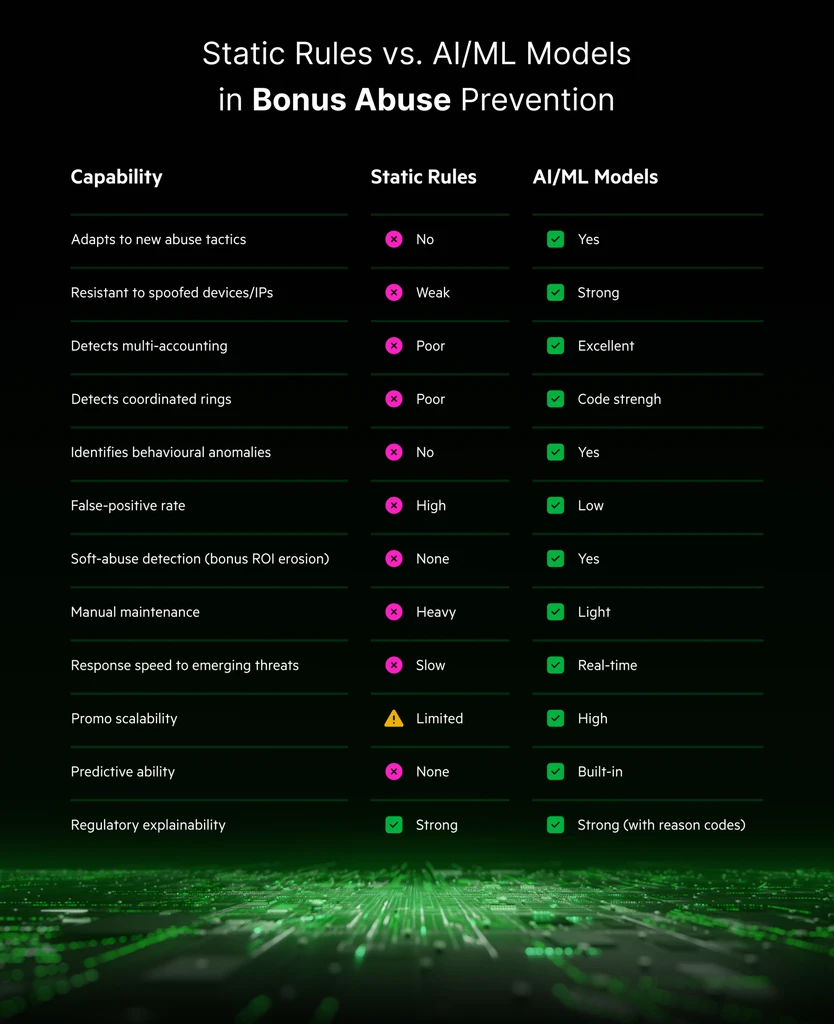
This is the core of the challenge. Many legacy fraud prevention systems rely on static rules that treat all players equally, flagging behaviour based on isolated triggers rather than context. Such an approach is increasingly misaligned with how modern bonus abuse operates.
As outlined in a white paper by EveryMatrix, bonus abuse has now evolved from isolated incidents into coordinated, network-driven activity designed to mimic legitimate player behaviour. Rather than standing out as it did previously, abusive activity is now deliberately engineered to blend in with normal user patterns.
In many cases, fraudulent behaviour no longer sits outside normal activity; it exists within it. This makes blunt detection methods not just ineffective but potentially damaging for the operator.
The result of this is an increase in false positives, where legitimate players are incorrectly flagged or subjected to unnecessary checks. For the player, this often translates into delays, additional verification steps, or disrupted gameplay, all of which introduce friction into what should be a seamless experience.
“Rules don’t distinguish between a bonus abuser and a loyal player,” Pettersen says. “That leads to false positives: genuine players that get blocked, frustrated, and that need to wait on manual processes to clear them. Some won’t wait; they’ll move to a competitor.”
Precision over prevention
With this in mind, Pettersen says the solution lies not in tightening controls further, but in making them more intelligent. “What’s needed is a shift towards understanding behaviour, not just reacting to isolated events,” he explains.
Rather than applying the same restrictions across the entire player base, operators are increasingly looking towards more targeted, risk-based approaches. These focus on building a detailed picture of individual player behaviour, allowing operators to assess whether an action is genuinely suspicious in context, rather than simply unusual in isolation.
Incidentally, such a challenge is reflected more broadly, with research from Experian suggesting that up to 35% of customers abandon online applications due to friction in the process.
This marks a noticeable shift in how bonus abuse is approached. Instead of asking whether a specific action looks suspicious, operators are starting to ask whether it looks suspicious for that specific player.
Modern bonus abuse is no longer a single-account issue, but a networked, coordinated activity that spans multiple accounts, devices and behaviours. Static rules, which evaluate events in isolation, are inherently limited in their ability to detect these patterns.
In contrast, more advanced systems analyse behavioural signals over time, identifying key anomalies in areas such as session patterns, deposits and withdrawals, game selection and bonus usage. This allows operators to detect subtle indicators of abuse much earlier, often before any financial damage.
Pettersen explains: “Player profiling shifts the question from ‘does this look suspicious?’ to ‘does this action look suspicious for this specific player?’. By building dynamic profiles, operators can assign risk scores that evolve as new data comes in, focusing attention where it’s actually needed.”
Crucially, this approach allows operators to act in a more targeted way. Low-risk players can move through the experience without interruption, while higher-risk accounts are subject to closer scrutiny. In effect, operators are empowered to segment their player base and focus attention where it is most needed.
The result is a model where fraud prevention becomes far less visible to the majority of users. Rather than introducing blanket restrictions or disruptive checks, operators can intervene more subtly, adjusting how and when bonuses are offered, or applying additional controls only where risk is identified.
In this sense, the goal is not simply to prevent bonus abuse, but to do so in a way that will preserve the integrity of the player experience. Seemingly, the most effective systems are those that operate in the background, reducing abuse without the player ever noticing.
Counting the cost of getting it wrong
While reducing bonus abuse is critical, the cost of overcorrection can be just as significant, particularly when it comes to high-value customers. Aggressive fraud checks, repeated verification requests or delays at key moments such as withdrawals can harm trust.
For many players, these friction points are enough to disrupt the experience. However, with VIPs, they can be a decisive factor in whether they stay or leave – with the loss of high-value players hitting operators particularly hard.
“The impact compounds the higher the value of the player,” Pettersen says. “High-value players have options, and a poor experience gives them every reason to use them. Friction at withdrawal or mid-session disrupts the very thing they came for.”
While bonus abuse may represent a relatively quantifiable financial risk, the loss of a high-value player can have a far greater long-term impact on revenue. Accordingly, controls must be robust enough to prevent bonus abuse, but not so suffocatingly intrusive that they undermine the experience they were designed to protect.
Increasingly, this means shifting away from visible, reactive interventions towards more subtle, targeted approaches that maintain trust while still mitigating risk.
From detection to prevention
More change is occurring in how operators approach bonus abuse more broadly. Rather than focusing just on confirmed cases, there is growing emphasis on identifying the early signals that emerge long before abuse is proven.
“Proactive detection means looking for subtle patterns before anything has technically gone wrong,” Pettersen explains. “Prevention always costs less than recovery.”
This was the thinking behind Bonus Guardian, EveryMatrix’s own AI-powered bonus abuse prevention platform, that has been built to keep operators on the front foot.
Behavioural indicators such as highly consistent betting patterns, tightly optimised bonus usage, or coordinated activity across accounts can often signal risk long before financial impact is visible. By identifying these signals earlier, operators can intervene in a more controlled and proportionate way.
Rather than reacting after abuse has occurred, they can reduce exposure gradually and avoid introducing unnecessary friction for legitimate players. Such an approach is designed to protect promotional spend and reinforce a more sustainable and player-centric approach to fraud prevention.
Rising to the challenge
It is clear that the challenge for operators is no longer just about stopping bonus abuse, but about navigating the problem in a cohesive and forward-thinking way.
As fraud becomes more sophisticated, so too must the methods used to combat it. However, sophistication should not come at the expense of player experience, which should always remain central to operators’ strategies.
It is clear that the most effective strategies are those that find a way to identify and mitigate such risk without disrupting the wider player journey, and the real competitive edge lies in solving both challenges at the same time.