When Is Free Not?
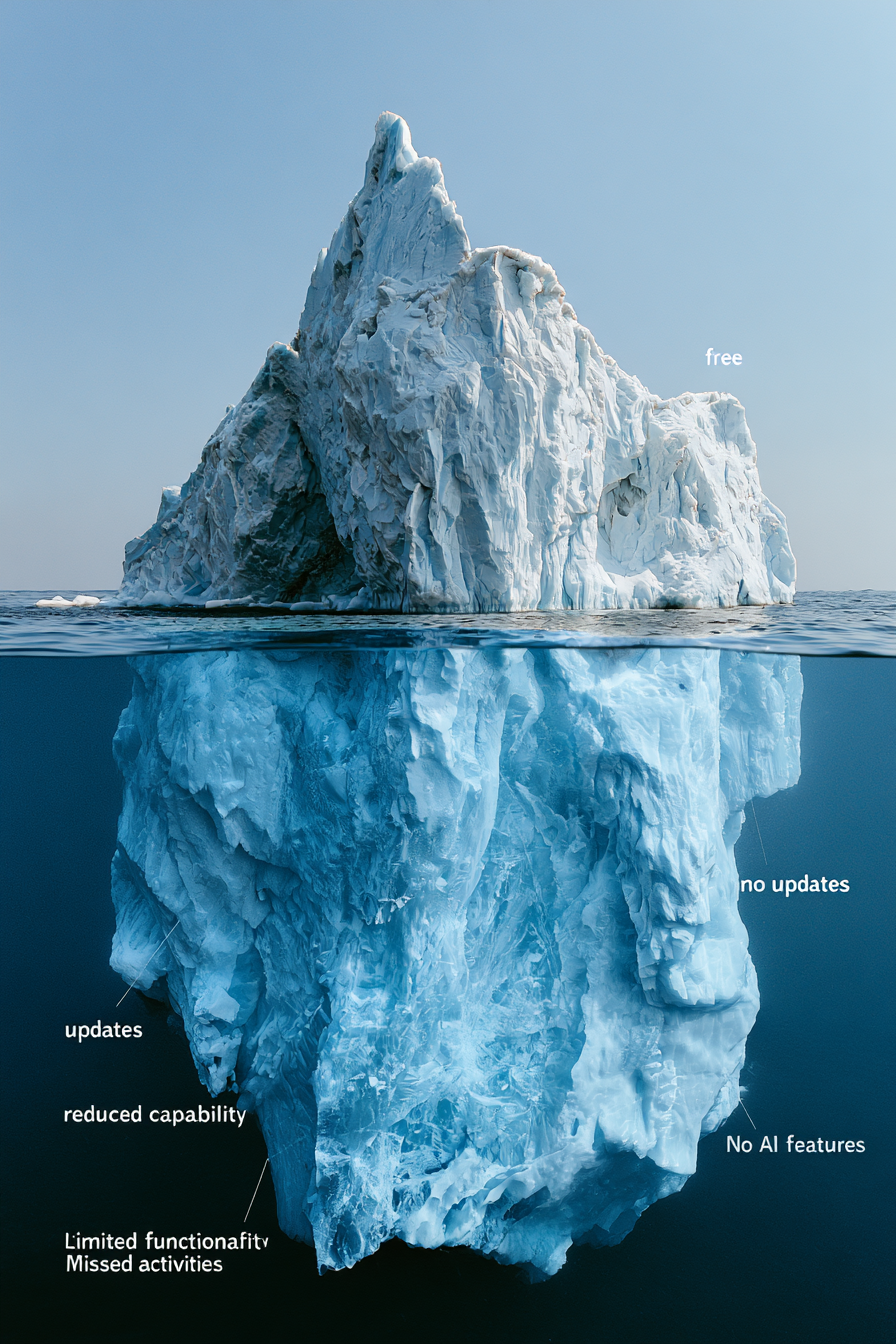
The central conceit around something being free is that it is automatically valued for its worth to you because it is not costing you any money. This is not, I would argue, the right way to frame the question. In fact, it is not even necessarily true.
There is a belief that something is free because it is not costing you any money, in the sense that there are no payments going out. But it is entirely possible that it is costing you money regardless. Certainly, when one looks at the fields of casino surveillance and security, the cost in question is not one of outlay, but the cost of a system failing to detect the underlying issue one is trying to guard against.
Take a piece of free software. The presumption has to be that it is doing something, but that it is free, so there is no outlay for it. But what if that underlying presumption is incorrect? What if it is not really doing what it is supposed to be doing? Let it be, for the sake of argument, some form of monitoring system, but one that is inefficient at monitoring the things one wishes to have monitored. It may well be that it is not costing any outward money, but it is nonetheless costing an opportunity cost of lost detections that it is failing to generate, by comparison with a payable product.
The Hidden Cost of Bundling
There is a further possibility. Perhaps what is being discussed is not free in the classical sense at all, but rather that its cost, because it does have a cost, has been subsumed within a higher billing rate for some other, associated product or capability. In this case, what is being described is no longer a free product but a product whose cost has been subsumed. This is not necessarily to say that the product is bad. But the question worth asking is: would one be able to pay for it as a standalone item in such a situation, and could that cost be deducted from the larger bill if it were removed? My suspicion is that one would generally find it to be an add-on considered free, which does not, in fact, reduce overall expenditure in any way. So again, one has to ask whether such a thing can genuinely be considered free, or whether it has to be looked at for what it actually is: something for which the cost is real, and has been subsumed within a larger cost for something else, a larger cost that is almost invariably substantial enough to cover whatever the product would have cost as a standalone item.
Free Software and the Absence of Development
If we are talking about a piece of software, one might ask whether its development has stalled, or was never going ahead, or indeed had not been developed in a considerable period of time. When questions are asked about that, the tacit response would, of course, be: well, what are you complaining about? It is free. You did not pay for it. That might not be verbalised to that extent, but that is not to say it is not what is being thought. If one is getting a product for free, what claim does one really have to it — to its development, to an enhanced feature set reflecting changes in core operating policies or procedures within one’s own organisation, or changes to rules and regulations within the industry, or, if it is a data input system, changes to how data is imported into it, its formatting, and so forth? One may find that a free system does not respond well to changes in environmental or policy and procedural baselines, simply because it is in nobody’s interest to develop it. It is in nobody’s financial interest. And that is the thing about commercial ventures, whether software, whether consulting, whether anything else: they are driven by the market, because the market is willing to pay for them to be so driven. Where the market is not willing to pay, would there still be sufficient effort put into development?
Here I am not talking about the likes of GitHub, where individuals, free of charge, make modifications to software. One may look to the Linux community, for example, whose members, of their own interest, put forward products, capabilities, or services that did not previously exist. They are not expecting a financial return for this. But many of these individuals are, in a great many cases, hobbyists, and they have to be, because they are not expecting a financial return. It may be done for altruistic reasons. It may be done for kudos. But if it is not being done for financial reward, and someone comes back and says that this element does not work, or that element does not work for them specifically, even though the overall outcome generally does, how motivated are individuals not working for wages towards fixing any problems that might arise or might exist?
The Free Consultant
Let us give a concrete example, since the above may seem somewhat abstract. Say a consultant came to visit at one’s place of work and said: I would like to perform some consultancy for you. Quite rightly, one asks: for how much? What is it going to cost me? And the consultant replies: it is free.
There could, of course, be a number of reasons why somebody would do such a thing. But, typically speaking, unless it were to build a business in the hope of some remuneration in future, one would be right to be pretty sceptical, because another word for free advice is quite often unsolicited advice. And when one receives unsolicited advice, the typical response is not: oh, thank you very much, that was awfully insightful, allow me to act upon it. It is rather: what business was it of yours to give me advice in the first place? So what would one honestly think of a consultant who said: I have some free advice for you, take it or leave it? My suspicion is that, in a great many cases, the response would be: I will leave it, thank you.
Netscape, Internet Explorer, and the Absence of Competitive Pressure
Similarly, one might recall Netscape Navigator and Internet Explorer, and I am well aware of how thoroughly I am dating myself by even knowing those names and what they were. Netscape Navigator was, at least originally, infinitely better than Internet Explorer. But Internet Explorer was bundled in for free. The reason for this, from Microsoft’s standpoint, was entirely sensible: they wished to kill off the competition for what everybody at the time believed, correctly as it turned out, to be the direction in which computing systems were going. One need only look at the internet as it exists now, and the fact that one can consume this very content should one choose to. But that bundling was done for a very direct reason, and it was not one that went unnoticed. The strategy became the subject of a major American antitrust case, United States versus Microsoft Corporation, brought by the Department of Justice in 1998, which found that bundling Internet Explorer into the Windows operating system, free of charge, was done specifically to undermine Netscape’s ability to sell its browser as a standalone product, and so to protect Microsoft’s dominant position in operating systems from any threat the browser might pose to it. The case stands as a fairly unambiguous confirmation, made by a court rather than merely by an observer of the market, that giving something away for nothing can be, and in this instance was found to be, a calculated competitive weapon rather than an act of generosity.
The functionality of Internet Explorer did, of course, improve over time, until it was, in its turn, entirely superseded by better browsers. One of the reasons it was superseded was that, being a free product, it did not receive the love and attention given to the underlying Microsoft operating system, whatever one might think of that system, which went through many iterations, or to the likes of Office, or now Office 365. Those systems, because they were paid for, were continually upgraded. Internet Explorer was not upgraded to anything like the same degree. This was subsequently used to advantage by later web browsers produced by companies with a different business model, one in which the price signal was much closer at hand, and which worked out considerably better as a result.
Leaving Goods, the Zero-Price Effect, and the Seen and the Unseen
Economics has a term for this, as it has a term for so much else. We speak of leaving goods: people put a premium upon those things they pay for, and discount, often radically, those things they do not pay for, or that come at a much lower cost. There is, of course, the old grievance that those in the public sector, not spending their own money, are less interested in securing value for that money than they might be were it coming out of their own pocket. I will leave that argument to one side, but I think we all know where we stand on it.
The more precise term for what is being described here is the zero-price effect. It is worth being exact about this, because it is easily confused with a related but quite different phenomenon, that of the Veblen good, and it is in fact something close to its mirror image. A Veblen good is prised because it is expensive: the high price itself is the attraction, a signal of status, and demand rises rather than falls as the price increases. The zero-price effect describes the opposite behaviour operating at the other end of the scale. It is not that a free good is despised for being cheap, in the way a status good would be. It is that a free good is discounted back to the point of being ignored, or barely considered at all, purely by virtue of costing nothing. We prise the expensive thing because it is expensive, and we overlook the free thing, or at least fail to scrutinise it properly, because it is free. Both are irrational departures from a straightforward assessment of worth, but they pull in opposite directions from opposite ends of the price scale.
This matters because the zero-price effect does not stop at the point of acquisition. It governs not only whether one takes up a free product in the first place, but how closely one continues to watch it afterwards. Discounting the worth or value of a free product means one is less likely to use it seriously, and less likely to keep testing it once it is in use. If one is less likely to scrutinise it — assuming it is a genuinely discretionary product — one is never going to see its limitations. Or, within the world of casino surveillance and security, one is going to miss the tells that would indicate one was suffering from fraud, whether real or potential, or that one had weaknesses in policy and procedure that would enable such fraud to be carried out in the first place.
So the question can legitimately be asked: when is free not? One is not paying money — that much is visible. But one is missing the things one does not see. One is missing the detections one would otherwise obtain with a better, paid product. Yes, there was a capital outlay for that paid product, but this is almost certainly repaid in actual outcomes, because there is a feedback mechanism at work: if the product does not do what it says on the tin, if it does not deliver the detections, if one does not like the results it gives, one stops paying for it. With a free product, that particular pressure is absent. There is no pressure to innovate. There is no pressure to improve. There is no pressure even to be genuinely good at what it is supposed to do. It is free, what does one expect? One sees what one expects to see, rather than the hidden costs.
It is very much akin to Bastiat’s broken window: one sees the cost upfront, the outlay, at zero, but not the missed opportunities, nor the frauds, which are far more likely to cost considerably more in the long run. So, very often, free is not free by any stretch of the imagination.
Conclusion
What runs through every example given here, whether casino surveillance software, a bundled feature, a free consultant, or a browser given away to kill off a rival, is the same underlying point: what is perceived to be free stuff very often, objectively, is not. There is no such thing as an economic decision without a trade-off; something is always given up, whether that is cash, attention, standing, or the quality of an outcome, and calling a thing free does not make that trade-off disappear, it merely moves it somewhere less visible. The genuine danger is not the trade-off itself, but what the zero price does to one’s willingness to look for it. Free things tend to be discounted, in the mind of the person receiving them, right back down to the level of being ignored, or barely considered at all, and it is that act of discounting, rather than the absence of a price tag, that is the real cost of free.