
Business is booming for many sports betting, prediction market, and casino operators.
According to July data from the American Gaming Association, the US legal sports betting handle reached a record $167 billion in FY 2025, with gross revenue up 23% year-on-year.
In the stock market, figures like these rarely go unnoticed, particularly when many of the companies at the top of the gambling food chain tree trade on major stock exchanges.
But gambling stocks are famously volatile. Heavily influenced by fleeting betting trends, tourism patterns, financial recessions, and quarterly reports, many financial managers say trading casino shares is not for the faint of heart.
That has failed to put many fund and wealth managers off, however. In fact, the data show that financial heavyweights such as major banks and national pension funds are among the world’s biggest casino stock buyers.
“You never really know what will happen in the short, medium, or long term,” Jacob Reynolds, the Asset Management Director at the UK-based wealth management firm Courtiers, told CasinoBeats.
“What we try to do is find good entry points based on fundamentals, giving ourselves a healthy margin of safety if things go wrong.”
Casino Stocks: Pro Investors Have ‘No Room for Emotion’
Casino shares are part of the so-called “sin stock” basket, which also comprises tobacco and alcohol producers.
Research has found that retail investors are “willing to neglect sin stocks and instead bear a financial cost in order to comply with societal norms and reflect non-financial tastes in their portfolio.”
Environmental, Social, and Governance (ESG)-focused funds screen for sin stocks, and initially proved highly successful. But in recent years, investors have dumped millions of dollars worth of ESG fund shares – leading some to reconsider casino stocks.
“Institutional investors don’t typically assess gambling businesses from an emotional perspective,” Andrew Bahlmann, Co-Founder at the South Africa-based financial firm Deal Leaders International, told CasinoBeats. “Rather, they tend to evaluate these companies based on three main factors: cash flow, recurring revenue, regulation, and long-term return potential.”
‘If the Valuation is Attractive, We are Willing to Invest’
Unless fund managers have a specific brief, experts say they will focus on bottom-line numbers rather than the kinds of concerns that would be a red light for many retail investors.
“If a gambling company can consistently demonstrate resilient earnings, disciplined management, and predictable growth, many funds will look at that company as if it were any other consumer-facing business,” said Bahlmann.
Concerns about what constitutes a “controversial investment” tend to fade away for institutional investors if the numbers add up, Bahlmann said.
“Gambling and casinos have existed for millennia,” said Reynolds. “For this reason, if the valuation is attractive, we are willing to invest in the sector. We have previously held positions in both 888 and Playtech. However, the price has to be right.”
Some fund managers have specific ethical guidelines that prohibit them from investing in certain sectors, Bahlmann said.
“They may choose to completely avoid the gaming sector,” Bahlmann added. “But on the other hand, those who are strictly fiduciary responsible and focused on portfolio performance may not be concerned about the underlying nature of a company’s operations.”
“Sophisticated” investors tend to spend “much more time evaluating aspects such as governance, regulatory exposure, and execution risk than debating whether or not a company operates within the gaming industry,” Bahlmann said.
The Search for Value: Investors Turn East
Despite recent business booms, many casino stocks are still trading well below their all-time highs.
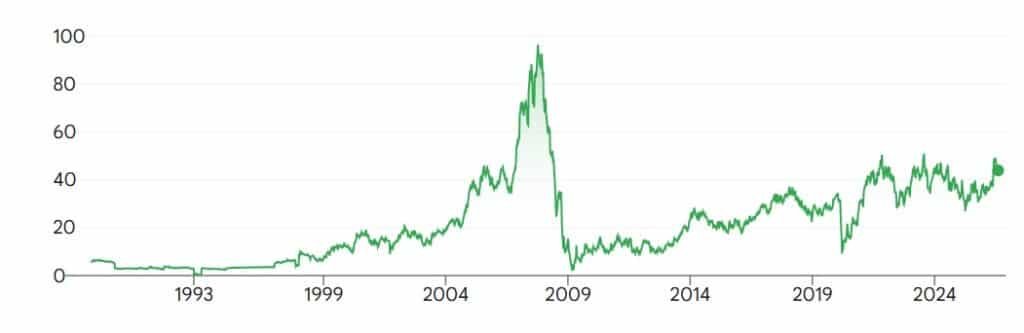
Professional investors say many casino stocks still have not recovered to pre-coronavirus pandemic levels.
The pandemic, they say, was a watershed moment for land-based operators. Post-pandemic economic downturns have also impacted the broader outlook for casino stocks.
North American, Australian, and European operators have all taken a knock. But Reynolds said that Asian casino operators “have had it even worse.”
“They are heavily dependent on gamblers from China, and China maintained strict [pandemic] lockdown measures well into 2021,” Reynolds added. “This was followed by a property market downturn, which left many potential customers feeling considerably poorer.”
However, this has left a situation whereby some argue that casino stocks have dropped to disproportionately low levels.
Some analysts have begun to give “overweight” ratings to casino stocks in regions such as South Korea.
In the world of stock trading, “overweight” shares are those forecasted to outpace the growth of benchmark indices in the medium term (typically between six months and a year).
Investors seeking bargain assets are also turning their attention to Macao-based operators that trade on the Hong Kong Stock Exchange.
“Looking at our model, several Asian casino operators are currently scoring very well from a valuation perspective, including MGM China, Galaxy Entertainment, and Sands China,” said Reynolds. “We have recently taken a position in China on the basis of a recovering consumer after several years in the wilderness, so these are companies I may examine more closely soon.”
The post Professional Investors Aren’t Squeamish About Casino Stocks, Say Financial Experts appeared first on CasinoBeats.