
“My brother made a very bad parlay bet that was incredibly stressful and for an incredibly large amount of money. After he had made that bet, he had a physiological response. My husband thought he was having a stroke. He hadn’t told us he had bet,” Dr. Mary Donohue tells me over a video call this week.
The incident led her brother to significantly change his betting habits, which he had maintained for almost 30 years. It also sparked an interest in how she could prevent others from making similarly bad choices in gambling.
She now runs the Digital Wellness Center, which describes itself as the world’s only wellness company dedicated to gamers. It aims to reduce online problem gaming by 25% by 2030.
It does this by using some of the same mechanisms that lead gamblers to develop problems: gamification. The company utilizes evidence-based digital programs and microbreaks to interrupt stress and boost recovery.
The Problems With Current Responsible Gambling Efforts
“Responsible gambling is an oxymoron,” Dr. Donohue says. “Gambling is supposed to be fun and a challenge.”
For many, it becomes something more problematic. Louis Ruggiero told CasinoBeats last week how his gambling addiction left him suicidal.
He was critical of gambling companies for fueling his addiction and said any efforts towards responsible gambling are nothing more than a receipt, something to point to when regulators come calling.
For Dr. Donohue, it’s more nuanced. She works with operators to improve the reach of their responsible gambling campaigns, or responsible recovery, as she calls it. She says 71% of people do not remember responsible gambling ads.
Partly, the problem with the current RG is that it is reactive rather than preventative. There are some groups working on prevention efforts, but in general, RG is aimed at fixing a problem that already exists.
“Current RG focuses on, ‘Oh, you’ve made a bad decision, you’ve bet over your normal amount. You should do this or this,’” she says. “What we measure is recovery and how recovery affects decision making.”
She added, “What we began to discover more and more is that the idea of a pause became very effective for people in terms of decision-making. What we know is that most well-being tools tell people to stop. But I have always believed there’s a better question, and that’s very salient to responsible gambling, because we want to know how people can recover from stress before it becomes a bad decision.”
A Stressed Population is Not Good for Anyone
Dr. Donohue’s work is focused on responsible recovery, she tells me. This might apply to gamblers, but it is a more holistic approach targeting an individual’s well-being.
“We’re specifically focusing on technology now because 82% of adults cannot put down their phones. Here’s another interesting fact: 66% of the world’s population, according to the World Health Organization, are stressed and suffering from stress-related diseases,” she adds.
“So that’s your customer base of six out of 10 customers who are gambling, and this is across the board and across generations. If six out of 10 people, 60% of your population, are stressed, are they making a good decision? The answer is no.”
“You go back to the principles of business. Does it benefit the business? Does it benefit the customer? Does it benefit the brand? Does it benefit anyone when a stressed consumer like my brother makes a bad decision?”
While some may say it benefits gambling companies that take the money of gambling addicts, Dr. Donohue disagrees.
“My brother was a great customer for gambling companies. He had bet for 30 years, and then this happens. That’s a horrible thing for the brand. Do you know what it costs to get a new customer? So, it’s not worth it for them to lose it. I would love to say that it’s all about human kindness and human love, but that would be ridiculous to say about any brand.”
Responsible Recovery Through Microbreaks
Microbreaks are one of the main techniques the Digital Wellness Center uses to reduce stress and encourage better decision-making. These do not interrupt gaming sessions, Dr. Donohue emphasizes, but are offered to users in a non-invasive capacity.
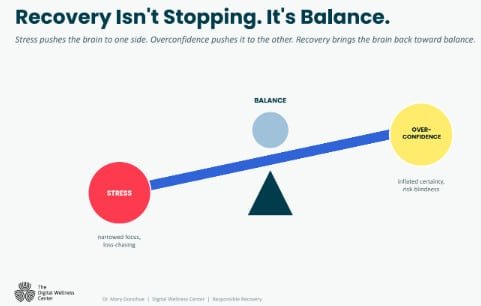
Recovery isn’t stopping, it’s balance, one of her slides in a recent presentation at the National Council on Problem Gambling conference stated. Stress pushes the brain to one side, overconfidence pushes it to the other. A microbreak can restore the balance.
She offers me a microbreak during our call. The conversation stops, and I am temporarily engrossed in solving the Droodle puzzles presented on the page. You can do one here, too.
“So when you did that little game, you were on our platform, represented by a casino brand,” she explains. “We ran a TikTok ad for them, which had 2 million impressions. That means 2 million of our target audience saw our ad. We were able to identify 1,100 highly stressed players who needed a break. Of those, 134 found results on the RG page. So 9% of high-stress players voluntarily took a break.”
She adds that a short break can have a huge impact on mood, with data showing “44% of the time you shift from stressed to happy in under three minutes.”
In a separate campaign with another online casino, she says they saw a 74% positive mood shift. “This is all before people have that problem, like my brother. They self-select. People are more than capable.”
The Science Behind Microbreaks
Dr. Donohue says she will bore me with the science behind how microbreaks can be so effective at shifting mood and helping gamblers make better decisions.
“When you took that break, what happened?” she asked. “You have to realize the effect the phone has had on your brain. Information is coming in from your phone at such a speed that your brain hasn’t adapted yet. So the longer you’re on your phone, clouds are starting to form, and unlike a car, there’s no check engine light that goes off for your brain to tell you, ‘Oh my gosh, you’re going into the bad decision territory.’ All you know is that you’re feeling really great or really bad.”
“We have to create balance for you to make a good decision. So what we do is clear this prefrontal lobe of clouds with an example like a game you just played. I watched your face. You were concentrating on it. You weren’t thinking about me watching you. You were thinking about the game and how silly the game is, and what a dumb thing the game is.”
“But that dumb thing just cleared some of the clouds in your brain, so your intrinsic brain connects to your mammalian brain, which is where your gut feelings are. If that can’t happen, your prefrontal lobe triggers something in your reptilian brain, which puts you into fight-or-flight mode, explaining my brother’s and gamblers’ responses that we’ve observed at tables or machines.”
Most gamblers lose money. But by clearing our frontal lobes, we can engage the part of our brain that is capable of making better, informed decisions about betting. Professors Robert Scott and Mikhail Sher also recently explained that these careful thought processes underpinned their successful betting strategies.
“My company was founded to help people help themselves make better decisions, and so obviously shifting your mood is part of that,” Dr. Donohue adds. “My goal with gambling is to give players the opportunity to help themselves before they follow the path of my brother.”
The post How To Make Better Decisions About Gambling Through Microbreaks, Explains Dr. Mary Donohue appeared first on CasinoBeats.