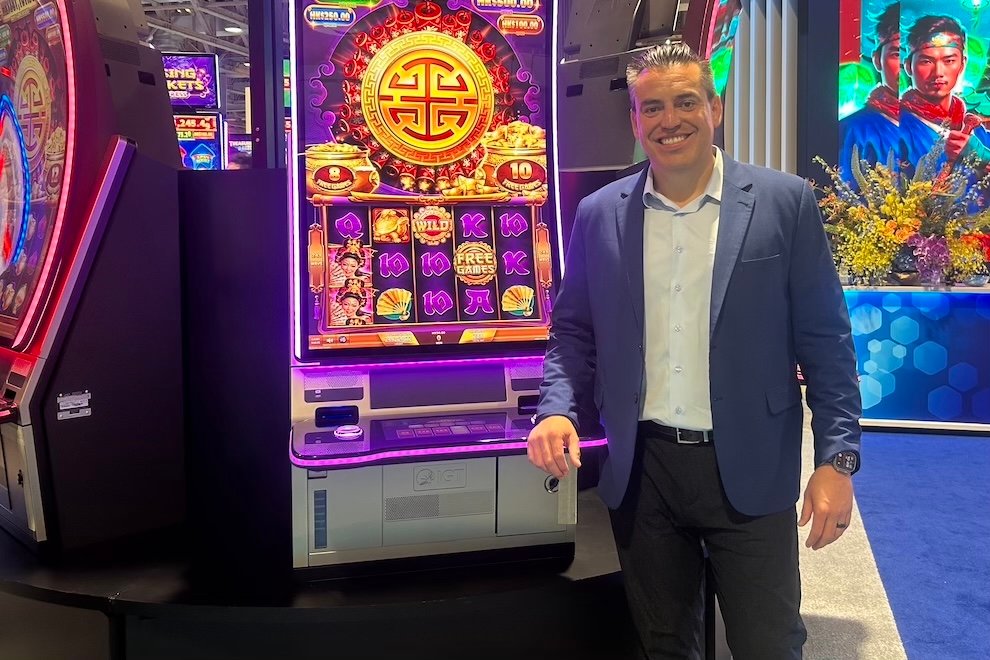
Hector Fernandez (pictured) is on a mission to turn around the business performance of casino equipment supplier IGT. After taking on the role of chief executive last December, he has been introducing a number of changes to the firm, an entity formed through the combination of casino technology supplier Everi Holdings Inc and International Game Technology Plc’s gaming and digital content business. That tie-up followed their 2025 acquisition by funds linked to private equity firm Apollo Global Management Inc. In a two-part interview with GGRAsia on the sidelines of the Global Gaming Expo (G2E) Asia 2026 trade show in Macau, Mr Fernandez discusses his vision for the new IGT and where he wants to take the firm.
You’ve been IGT’s CEO for half a year now. What has changed so far in the company?
So much. When I was thinking about joining IGT, one of the things that was very clear to me was that it had all the right pieces. If you look at the history of IGT over the last 20-plus years, IGT used to be number one, and then lost its way. But it’s interesting because it lost its way from a commercial standpoint, while from a product legacy standpoint, all the best math models had been developed by IGT. A lot of the industry’s iconic intellectual property was developed by IGT. It has the number-one third-party brand in the industry, “Wheel of Fortune”. So, I looked at this opportunity and I said, ‘Look, all the right ingredients are here. We just need a new recipe. And we need different chefs to execute that recipe.’
What is that different recipe?
The different recipe is very simple: it’s our strategy. We call it the ‘five Cs’, and they are in order of priority. Culture is the first ‘C’; capabilities is the second; content is the third; commercialisation is the fourth; and cash-flow creation is the fifth.
Let me explain a little bit more, going in reverse order.
Cash-flow creation: it’s all about driving efficiencies in the business. As an organisation, IGT had become a bit inefficient. As Everi and IGT came together, we needed to make sure we drove a lot of efficiencies so we could find the cash to reinvest in the business. We’ve been on that journey: we undertook some restructuring a couple of months ago to really drive home that integration and find the cash…
There were staff redundancies…
That is exactly the reason why. Cash-flow creation is important because you can’t just invest without creating efficiencies; you have to be responsible with your investments.
Commercialisation is the fourth ‘C’. That’s about being more customer-centric. I’m probably the only CEO among the major gaming supplier companies who is in Asia [for G2E Asia 2026]. That is really important because it signals to customers the importance of this market to IGT. I really believe that this market will drive a significant part of the IGT turnaround.
There’s also an element of pricing, i.e., making sure competition drives price discipline. Without competition, suppliers will tend to continue raising prices and customers lose leverage. I talk a lot about that with customers. It’s important in any market to have a minimum of three competitors, ideally three to five. Any market that has only two competitors is not a good situation for the customer.
Content is the third ‘C’: this business is all about content. That’s what players ultimately put their money on. A lot of the cash-flow creation that we have achieved, we’re investing in developing world-class content. Part of that content strategy is enabling the studios to drive their creativity, with some guard rails around it. Where IGT had lost its way was in the organisation dictating to the studios what to create. Really, the studios are the creative force behind any company. Changing that narrative and shifting the decision-making authority was really important. Then there is bringing in fresh content talent: we’ve been very aggressive in attracting content professionals to the organisation. Several have already made the decision and are simply waiting out their non-compete clauses.
Additionally important are capabilities, the second ‘C’. That’s all about making sure that people are in the right jobs. When I got to IGT, it was very clear there was a lot of talent, but it was also very clear there was a lot of talent in the wrong jobs. There was this perception that if you had a huge team, that’s how you got promoted. I don’t believe that. I think outcomes are what drive whether someone gets promoted or how they are rewarded, not how many people work for them. Sometimes, when you have a smaller organisation, you can drive better outcomes because you’re more nimble and closer to the detail and the problems. That’s the first part of capabilities.
The second part, quite frankly, is that there are a lot of great capabilities that exist outside the industry that historically it had not been very open to. I’ve been in gaming now for eight years and I’m still considered an outsider. A lot of the capabilities that we’ve attracted to the new IGT are from people outside the industry. If you think about areas such as data and analytics, the business is not known for being world-class in that area. So, the person we brought in to lead that field does not come from a traditional gaming background but from a fintech background where they handled extensive data analytics. Our head of marketing is a similar story. We looked at the business and said, ‘What are the capabilities we need? Let’s be open-minded about how we acquire those capabilities.’
And then the first ‘C’, which is by far the most important: culture. You can have the greatest product in the world, you can have record earnings, and people can still hate going to work. If that is the environment you’re operating in, it becomes very hard to stay on top. Culture is very simple in my mind: if three out of five days per week you wake up and go to work hating your job, it’s time for you to do something different. It’s something we are still working towards. We definitely are not there yet. My intent is to build a culture of meritocracy where people are rewarded for outcomes and not for who they know.
IGT is now private, controlled by Apollo Global Management Inc, which has a track record of gaming industry investments. How does that help you in your job? What does Apollo provide?
The first thing that Apollo has provided is a shift from IGT being short-term focused to being long-term focused. When I was deciding whether I was going to take this job, one of the things I was very clear about with Apollo was that this would take time. To think that we would come here and change the trajectory of the business overnight, that doesn’t happen. What they told me was: ‘Go build something for the next 10 years, something that’s sustainable, that we can all feel proud of, something that we can look back on and say we brought IGT back to its old glory days – without the arrogance.’ That was really refreshing to me because private equity historically has had this stigma or reputation for being very short-sighted; It’s actually quite the opposite. In my previous experiences, I would have to focus on these 13-week reporting cycles. I don’t have to do that anymore. That doesn’t mean we don’t have quarterly discipline, but it means that I can make long-term decisions. That’s really helpful.
The other thing that’s really helpful is that a typical public-company CEO spends roughly 70 percent to 80 percent of their time on three things: investors, the board, and M&A [mergers and acquisitions]. I spend roughly 10 percent of my time on that, and here’s why: my investor is Apollo. My board is Apollo. And with any M&A opportunities, they do all the due diligence because that’s what they’re good at. That’s incredibly helpful. It allows me to refocus my time: a third of it meeting customers; a third visiting employees and building culture; 20 percent to 25 percent building for the future; and then the rest of the time on what a typical CEO has to do.
The other thing that’s helpful with Apollo is that when I have to make a major decision, I don’t have to wait for a board meeting or write a board paper. I literally just pick up the phone and call. I called them this morning about a decision I was going to make. It was a five-minute conversation. That is a very different situation from being a public-company CEO.
Another important point that most people don’t realise is that Apollo owns many different companies. So, I have access to talent outside my own company. Let’s say I’m dealing with a supply-chain issue. I can tap into the Apollo network and see whether any other company has dealt with the same issue and, if so, how they solved it. So, I don’t have to reinvent the wheel. That background support is incredibly powerful. Because of the way it works, it’s not a sign of weakness that I ask for help. It’s a sign of strength because Apollo people know that’s the most efficient way to solve a problem.
You mentioned M&A. The new IGT is the result of an integration with Everi. How is that coming along?
I am very pleasantly surprised by how far we’ve come in such a short period of time. Historically, M&A integrations take three years. That is not to say that there are not still things we have to do. One of the things that we were very clear about is that this isn’t a typical M&A integration. We’re going to move at speed and we’re going to make decisions. We’ll make mistakes, but we’ll course-correct when we do.
I’ll give you an example. We decided to take the fintech business, which was historically an Everi business, and the systems business, which was historically an IGT business, and put them together. The reason that was so important is that you’re not selling customers separate fintech and systems solutions; you’re selling them an integrated solution designed to increase revenue and drive efficiencies. Part of that strategy was to create a holistic solution for customers that improves casino operations and makes them more efficient. We’re reshaping the sales organisation: if you’re my customer, you deal with one person, and that individual takes care of everything behind the scenes to resolve whatever your issue is. That’s never been done in this business before.
(Click here to read the second part of this interview)