The sports betting industry of decades past is a far cry from the cutting-edge tech employed today, and the emergence of prediction markets has unlocked new market-making opportunities for bookmakers seeking to make the most of the sector’s disruption.
Traditional sports betting businesses and prediction markets share some loose similarities, such as financial modelling and pricing. However, predictions are categorised as derivative exchanges, and therefore rely partly on market-making to ensure liquidity between buyers and sellers. Earlier versions of prediction products, like Betfair in the UK, ultimately failed due in large part to a lack of liquidity. In sports betting, the book acts as the counter-party to all trades, removing the need for such mechanisms.
The blurring of lines between finance and wagering has presented challenges for bookmakers, but many of the largest betting companies have joined the predictions space in some form. If market-making is essentially a form of bookmaking in that it involves accepting risk in the hopes of profiting on event outcomes, bookmakers have the opportunity to excel in that somewhat nascent space, and they appear to be doing just that.
On DraftKings’ Q1 call, CEO Jason Robins said his company should have “one of the top two or three market-makers in the world” for sports contracts, “arguably the best,” given their modeling capabilities”. He added that he doesn’t see any potential challengers “outside of maybe one or two of our big sportsbook competitors”. Flutter CEO Peter Jackson also said on his company’s call that FanDuel is actively deploying in-house market-making services.
Both companies’ stocks are down more than 30% year-to-date, with prediction-related capex contributing to investors’ malaise. But the opportunity to quickly climb to the top of the market-making profitability pool could make the complex practise a hot commodity in the near future.
Research explores market-making strategies
This week, gaming researchers and academics flocked to Las Vegas for the 19th edition of UNLV’s International Conference on Gambling and Risk Taking, a triennial event centred around cutting-edge research on gambling topics.
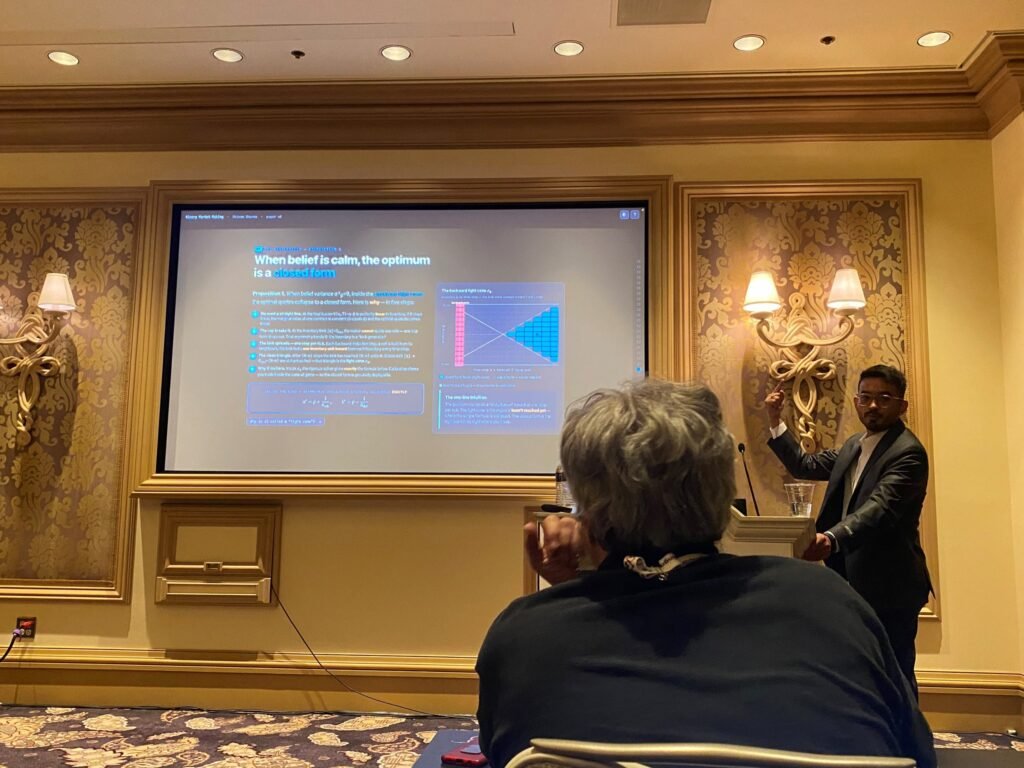
On Tuesday, UNLV PhD candidate Shivam Sharma presented research titled “Optimal Bookmaking with CRRA Utility: Existence, Uniqueness, and Numerical Methods”, which explored best practices for market-making with the example of Kalshi contracts on MLB games. The 20-minute presentation was a dizzying deep-dive into financial and statistical modelling that at times felt like a doctoral-level course at the likes of MIT or the Wharton School.
“How it happens is, there’s a liquidity provider, he goes out there, posts his limit order on both sides, and then a liquidity taker comes and takes the offer,” Sharma said at the onset of the presentation. “It’s this dynamic between the liquidity provider and a taker that moves the prices…How can I post my limit orders, in which sequence, so that at the end of the day, I make a certain amount of profit? This is the entire machinery at play — posting limit orders in an intelligent way that they get filled and I earn the bid-ask spread, as simple as that.”
The meteoric rise of prediction markets has quickly made market-making an attractive opportunity to take advantage of the influx of inexperienced traders or opportunistic prices, similar to the stock market. But there are key differences in modeling for predictions instead of stocks, Sharma said, due to different payout structures and probabilities (event contract prices are affected by the event itself).
“There are some papers about an automated market-maker, but…there’s nothing out there as of now that tries to formulate this problem in a mathematical framework and tries to solve it,” Sharma said.
Inventory control and risk management
Sharma explained that in market-making, inventory control is perhaps the biggest consideration due to price changes. Tomorrow’s price is different from today’s price, which can be dangerous given the volume of stakes at risk.
“As a market-maker, what you are really interested in is making sure that your inventory is within a certain bounds, so that you cap your risk potential, or risk-taking capability,” he said. In his example of MLB trading, Sharma stressed that his methodology relies on strategic implementation around certain periods of a game, not for the whole contest.
This type of continuous risk management is well-known to bookmakers, especially with regard to in-game betting and live pricing updates. In one example, analysts at Eilers & Krejcik Gaming said in January that major US sportsbooks all posted uptimes of 65%+ for college football games. In betting parlance, uptimes are defined as the portion of an event in which at least one betting market is live.
Among major books, DraftKings topped the category with average uptimes of 86%. The average overround, EKG’s metric for operators’ expected return on turnover, exceeded 5% for all books, with BetRivers perched atop the leaderboard at 8%+.
In DraftKings’ case, Robins is confident that the company’s years of betting prowess can quickly translate to a new market-making revenue stream.
“In terms of profitability versus investment, the market-maker should be or is profitable already,” Robins told analysts at this month’s earnings call. “That’s gonna be the one that’s sort of the least capital intensive in terms of investment, and I think it will produce really strong results in the near-term and continue to grow.”

Jess Marquez
Jess has covered the global gaming industry since 2022. A native of Reno, Nevada, he’d like to note that it’s Ne-va-da, not Ne-VAH-da.