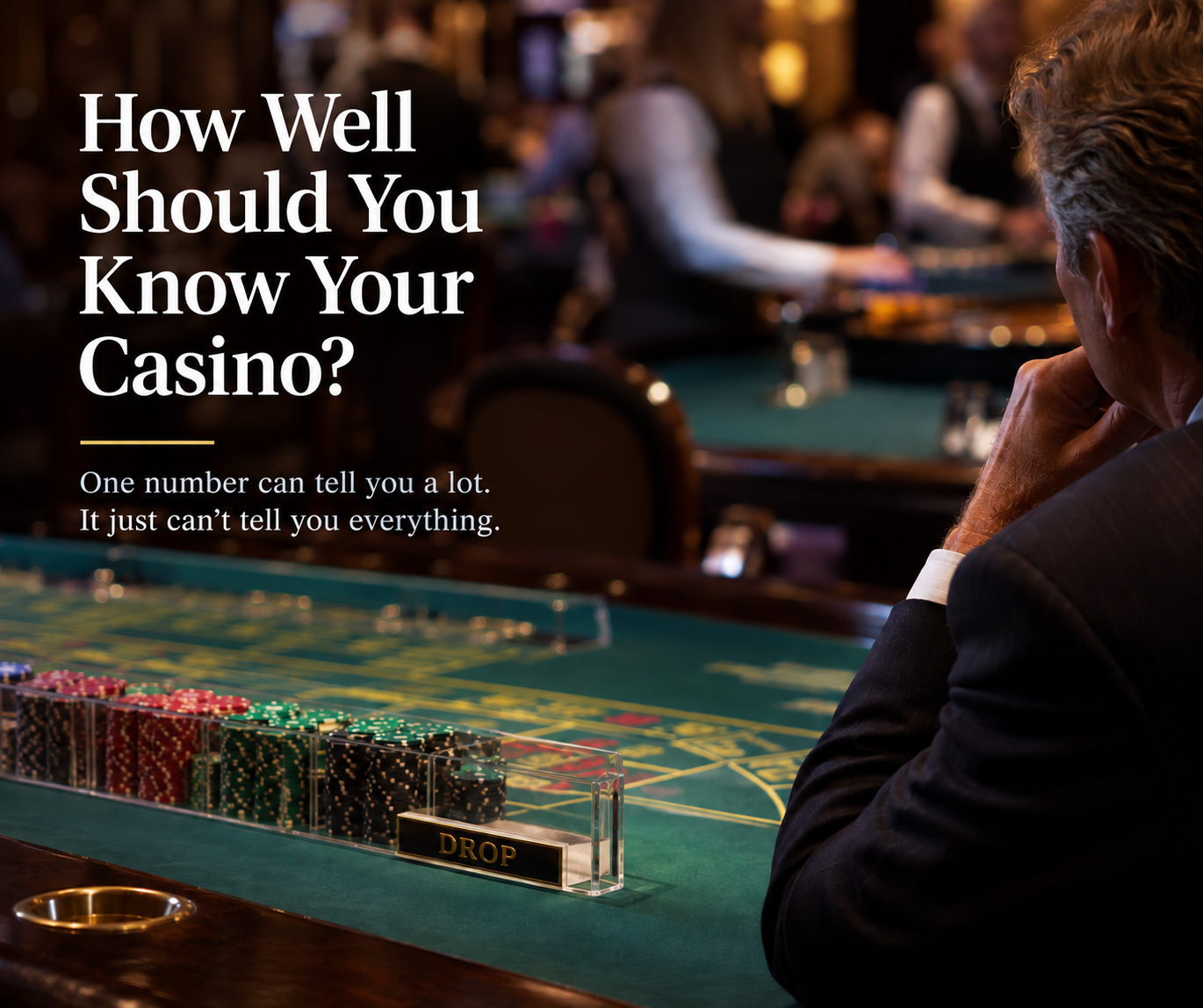
Many years ago, I worked for a casino group where the owners and quite a few of the senior executives had developed a fascination with table drop.
It came from someone they respected, one of the management gurus advising the group at the time, who had told them that as long as the drop was there, there wasn’t much to worry about. I can’t remember the precise wording after all these years, but that was certainly the message that survived.
And there was logic to it. If people were coming into the casino and putting money on the tables, you had customers and you had activity. Hold would move around, sometimes pleasantly and sometimes in ways that made the morning revenue meeting a less enjoyable experience, but over time the mathematics should take care of themselves.
So we watched the drop.
Quite a lot.
Eventually it seemed that almost every discussion about the table business found its way back there. As long as drop was holding up, there was a certain feeling that the patient still had a pulse and therefore couldn’t be in too much trouble.
Of course, there were quite a few other things going on with the patient.
Customer mix mattered. So did reinvestment, labour, credit, game mix, frequency and how dependent we were becoming on a relatively small number of players. Hold could make us look clever one month and rather less clever the next without management having done anything particularly different. We could also spend an impressive amount of money generating that drop if we really put our minds to it.
Drop remained useful. It just wasn’t the universal health check it had somehow become.
I’ve remembered that episode many times because I’ve subsequently seen plenty of variations of it. The number changes. The thinking doesn’t change quite as much.
People tend to understand a casino through whatever part of it they know best.
Someone with a finance background naturally feels comfortable with revenue, margins, costs and EBITDA. A tables person looks at drop, hold, limits and labour. Slots people have coin-in, win per unit, occupancy, denomination and product performance. Marketing has visitation, frequency, database activity and reinvestment. Then there is the owner who knows the top twenty customers personally, including where they like to eat and what whisky they drink, but might struggle to tell you what is happening to the other few thousand.
All of these are perfectly legitimate ways of looking at a casino. The difficulty starts when one of them becomes the way of looking at the casino.
I’ve worked with owners who knew relatively little about casino operations and were quite open about it. Curiously, that was often easier. They asked questions. If they didn’t understand something, they said so. They employed people who did understand it and, provided those people were good, life could be surprisingly straightforward.
The more complicated cases were often people who knew the business reasonably well.
Or part of it, anyway.
That’s a fairly human problem. Once we know a subject well, we tend to become more confident about the neighbouring subjects too. I’ve been guilty of it myself. After a few decades in casinos you can develop the dangerous impression that you’ve seen everything, usually shortly before somebody demonstrates that you haven’t.
Casinos are particularly good at doing that because almost nothing happens in isolation.
Let’s say gaming revenue is up 8% this month.
Excellent.
Probably.
Before celebrating too enthusiastically, I would want to know where it came from. Perhaps visitation increased. Perhaps customers came more frequently. Perhaps average spend increased. Maybe three premium players had a truly miserable weekend. Perhaps table hold was unusually favourable. Maybe we spent considerably more on promotions to produce the increase. It is even possible that the underlying customer base weakened while a handful of players made the headline number look wonderful.
All of those possibilities can produce the same +8% on the first page of a management report.
I’ve seen the reverse as well. A perfectly decent operating month can look awful because a few large players won. Everybody becomes depressed, explanations are requested and somebody inevitably produces a PowerPoint. Three months later the same players lose, everybody congratulates themselves and, strangely, fewer PowerPoints are required.
That’s gambling.
It is also why I’ve always had a slightly complicated relationship with management reports.
I like data. The longer I spent in the industry, the more important data became to me. In fact, one of the bigger changes in my own thinking over the years was realising how much marketing and data tell us about a casino, particularly when you combine them with what you can see happening on the floor.
But I’ve also seen reporting packs large enough to qualify as gym equipment.
Everything is in there. Revenue by department, variance to budget, variance to last year, drop, handle, hold, coin-in, win per unit, visitation, player segments, reinvestment, payroll, promotional results and several pages of commentary explaining why most of it wasn’t quite management’s fault.
The numbers can all be correct and you can still misunderstand what is happening.
Slot win is up 12%. Fine. What happened to coin-in?
Visitation increased. Who visited more often?
A promotion produced €500,000 in gaming revenue. Very nice. How much of that would we have had anyway?
Payroll percentage improved. What happened on the floor?
Premium revenue increased substantially. What did we spend to get it, and how concentrated has the business become?
Those aren’t particularly sophisticated questions. They simply require some understanding of how one number relates to another.
And that, I think, is where casino knowledge becomes interesting.
When I started in the business, I was a tables person. Tables were enormously important to me, partly because they were enormously important and partly because that was what I knew. If you had asked me then what someone needed to understand to run a casino, I suspect my answer would have contained rather a lot of table games.
Later I became involved with slots. Then broader operations. Marketing became increasingly important, as did data. I worked in some large organisations and some very small ones. In one of the smaller casinos, I occasionally repaired slot machines while already working as assistant general manager, which probably says more about the size of the operation than about my technical abilities.
It was useful, though.
Every time I moved into another part of the business, something I thought I understood became slightly more complicated.
Marketing is a good example. From the outside, it can look like the department that runs promotions, sends offers and organises events. Once you start properly looking at customer behaviour, frequency, segmentation, reinvestment and retention, it becomes difficult to separate marketing from gaming performance at all.
The same happens everywhere.
Cutting payroll looks sensible on a spreadsheet. It may still be sensible after you understand the effect on service, although occasionally it becomes less attractive.
Reducing reinvestment improves profitability immediately. Customers generally have the bad manners not to change their behaviour immediately, so for a while this can look like an exceptionally clever decision.
Adding another hundred slot machines gives you another hundred slot machines. Whether it gives you another hundred machines’ worth of business is a separate matter.
Growing premium play can be wonderful until you look at volatility, credit, comps and concentration. It can still be wonderful afterwards, but at least you’re now looking at the same business from both ends.
This is why I find the question of how much an owner or board member should know about casino operations more interesting than it first appears.
They certainly don’t need to know everything.
I don’t particularly want an owner deciding which slot cabinet should replace another. Nor does a board member need to work out how many blackjack tables should be open at two o’clock on Saturday morning. There are people employed to do these things, and they generally appreciate being allowed to do them.
But there is a considerable difference between operating the casino and understanding what drives it.
Management will always know more about the day-to-day operation than ownership. That’s normal. The slot director should know more about slots. The marketing director should know more about marketing. If they don’t, the owner has a considerably easier problem to solve.
The interesting question is how much the owner needs to know in order to understand the answers coming back.
Why did revenue decline?
The market was soft.
Quite possible.
Why did marketing costs increase?
Competition intensified.
Also possible.
Why is slot productivity falling?
We need newer product.
Again, perfectly plausible.
At some point, however, somebody has to know what to ask next.
If the owner or board has no independent understanding of the business, management ends up both running the casino and explaining to ownership how successfully it is running it. That doesn’t mean anyone is being dishonest. Most of the time they aren’t. But every department naturally sees the world from its own perspective, and nobody I’ve met has been completely immune to presenting results in the most sympathetic available light.
Including me.
There is another side to this which I find even more important.
Owners don’t just receive information from an organisation. They also send signals into it, often without realising they are doing so.
That casino group I mentioned earlier learned that drop mattered enormously to ownership. Naturally, drop received enormous attention.
If every conversation from the top is about EBITDA, the organisation becomes very interested in EBITDA. If the owner loves VIP business, VIP proposals tend to have an easier journey through the building. If marketing expenditure gets questioned every month, marketing eventually becomes rather creative in demonstrating why every euro is essential.
This isn’t necessarily manipulation. It’s what organisations do. People work out what matters to the people above them.
I’ve sat through enough management meetings to know how quickly this happens. One question asked by the chairman every month will eventually receive more attention than ten KPIs that might objectively be more important.
So the owner’s understanding of the casino has consequences beyond whether they correctly interpret the monthly report. Their interests, blind spots and favourite numbers can slowly influence the way management runs the business.
Which makes knowing what to ask rather important.
There is, of course, another extreme.
The owner learns enough about the business to become enthusiastic.
Suddenly the slot director has a new assistant he didn’t request.
Individual comps are being discussed. A promotion has been redesigned over lunch. Someone has noticed that a particular bank of machines looked quiet at 3:15 on Tuesday afternoon and would like to know why we still have them.
I’ve seen versions of this too.
Understanding the business and operating it are different jobs. In fact, I would argue that owners who genuinely understand casino operations should probably feel less need to interfere with them. They know which questions matter, but they also know why they hired specialists.
So how much should they know?
I’m not sure there is a neat answer.
Enough to understand where the revenue really comes from.
Enough to recognise the difference between gaming variance and operational performance.
Enough to understand customer value beyond last month’s win.
Enough to know that marketing revenue and incremental revenue aren’t necessarily the same thing.
Enough to understand what reinvestment is buying.
Enough to recognise when an apparently excellent number looks lonely and needs some company.
Most importantly, enough to keep asking questions when the first answer doesn’t quite explain what they’re seeing.
I sometimes wonder what would happen if you took the monthly report of an average casino and removed all the management commentary. Give the numbers to the owner, the GM, the CFO, the head of marketing, the tables director and the slot director separately and ask each of them to explain what is happening in the business.
I suspect we’d get six rather different casinos.
And in a strange way, they might all be right.
That old obsession with drop wasn’t foolish. There was genuine operating wisdom behind it. If customers are continuing to bring money to your tables, you have a rather important ingredient of a successful table business.
We simply gave that one ingredient more responsibility than it could reasonably handle.
I’ve seen plenty of other favourite numbers since then, and I’m sure I’ll see a few more. Every casino seems to have them. Sometimes they come from the owner, sometimes from the GM, sometimes from the latest consultant and occasionally from something somebody heard at a conference and wrote down.
Most contain some truth.
The casino tends to be hiding in everything around them.
After more than thirty years in the business, I’m less certain about many things than I was after ten. I consider that progress, although it took me a surprisingly long time to get there.
An owner doesn’t need to know how to run every part of a casino. Neither does a board member, and I’m not convinced even a general manager can know all of it anymore.
But if you’re responsible for the business, you should probably understand enough of it to know when the picture you’re looking at is missing a few pieces.