One of the quickest ways to understand how a casino is actually run is to watch a shift handover.
Not the formal briefing with printed reports and polite summaries.
The few minutes before and after that, when supervisors exchange what really happened.
Who played. What went wrong. What was adjusted. What still needs attention.
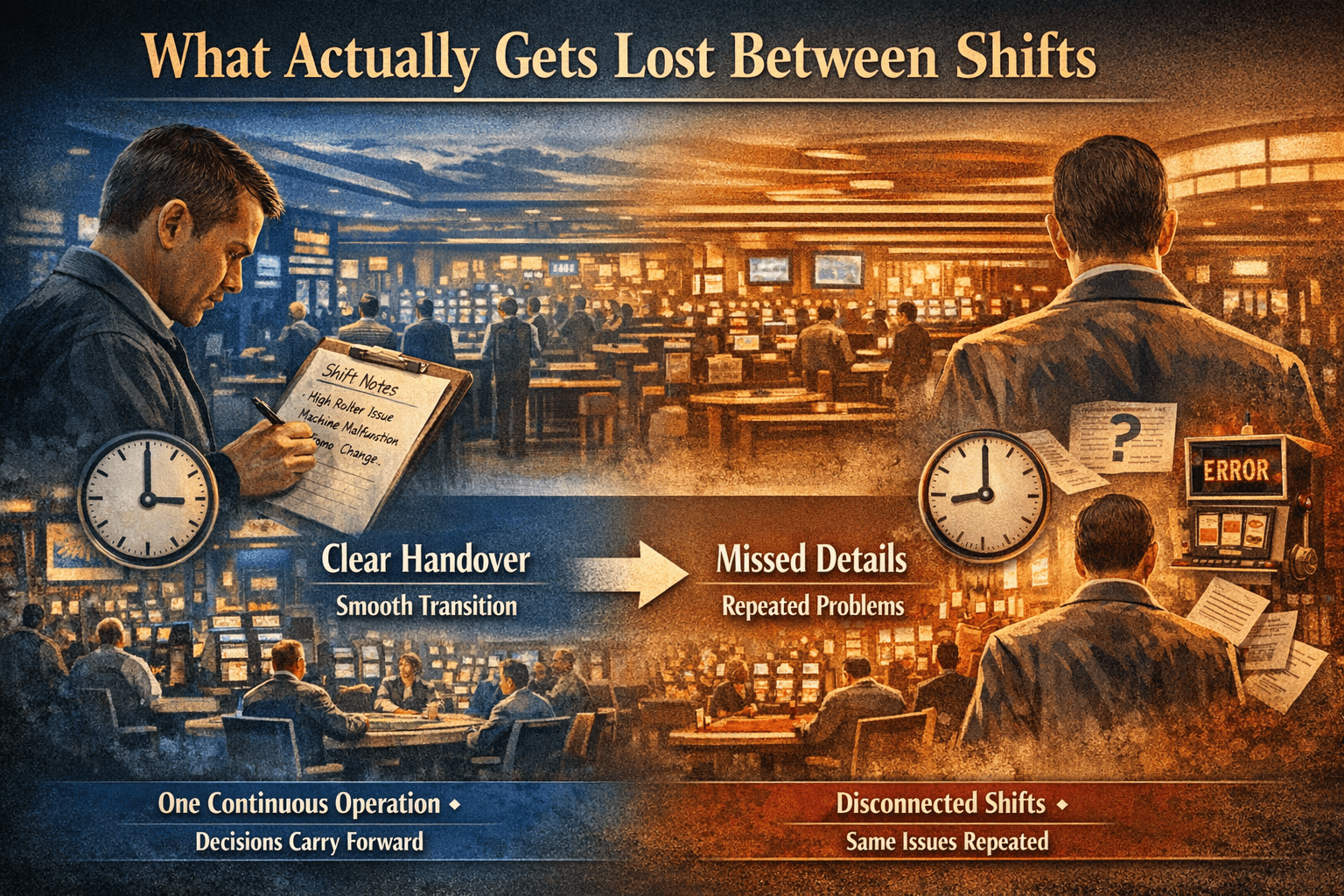
In some properties, those conversations are short and precise. Decisions carry forward.
In others, the same issues resurface twelve hours later as if nobody had mentioned them before.
It sounds minor. It rarely is.
A casino is one of the few businesses that runs continuously while responsibility rotates. The building doesn’t close, the players don’t reset, and the operation doesn’t pause. Only the people do. Every shift change is therefore a small test of whether the place is being run as one continuous operation or as a series of loosely connected ones.
When it works well, the incoming team knows what decisions were made and why. They know which players were on the floor, what was offered, what was promised, and what should or shouldn’t be repeated. Small adjustments made at 18:00 are still in place at midnight. Issues don’t get rediscovered; they get managed.
When it doesn’t, the floor develops a kind of short memory.
The same conversations happen again.
The same questions get asked.
The same decisions get reconsidered.
No one notices at first because nothing dramatic is happening. The operation is still functioning. Players are still playing. Revenue still comes in. But over time the lack of continuity creates drag. Pace slows. Accountability softens. Small inefficiencies compound.
I first became properly aware of this years ago when taking over a property that, on paper, was performing well. The numbers were healthy, the team experienced, the systems in place. Nothing looked broken. Yet the place felt slightly heavier than it should have. Conversations repeated themselves. Decisions took longer than expected to settle.
After a few days it became clear that most of the friction appeared at shift boundaries. Not because people weren’t competent or engaged. Quite the opposite. Everyone was working hard. But each team was, in a subtle way, starting its own version of the day.
A decision made in the afternoon might be treated as a suggestion by the evening.
An adjustment made at night might be reconsidered in the morning.
Nothing openly contradicted, just quietly reset.
We introduced a very simple habit. Each shift logged one operational decision that had been made and why. Not everything, just one. Something that had required judgment. It could be a player handling approach, a floor allocation, a service adjustment. The incoming shift acknowledged it and either continued with it or changed it deliberately.
It wasn’t a grand system. It didn’t require new software or meetings.
But it created continuity.
Decisions started to carry weight across shifts instead of dissolving between them.
Within a few weeks, the pace of certain things improved. Fewer repeated discussions. Less rediscovery. More sense that the operation was one continuous entity rather than a set of well-run fragments.
You see similar patterns in many properties.
Where continuity is strong, the floor feels calm even when it’s busy.
Where continuity is weak, the place feels slightly unsettled even when things are going well.
None of this shows up clearly in reports.
It shows up in rhythm.
The best-run operations tend to have a shared memory. Not just written procedures, but a sense that decisions matter beyond the shift in which they were made. Supervisors trust that what they decide won’t be quietly undone without reason. Incoming teams feel responsible for carrying forward what they inherit.
This doesn’t mean rigidity. Situations change. New information appears. Adjustments are made. But those adjustments are conscious, not accidental. The operation evolves through decisions rather than drifting through resets.
In properties where shift continuity is weak, the opposite happens.
People become cautious about making decisions because they know they might not hold.
Conversations become repetitive.
Energy gets spent re-establishing context rather than moving forward.
Again, nothing dramatic. Just a gradual loss of momentum.
One of the interesting aspects of casinos is that many operational improvements don’t come from large structural changes. They come from small habits that accumulate. A clearer handover, a slightly stronger sense of continuity, a shared understanding that decisions carry forward unless deliberately changed. These things rarely make it into strategy documents, but they shape how the place runs day to day.
If you walk into a property and want a quick sense of its operational discipline, watch what happens at shift change. Watch how supervisors talk to each other. Whether they refer to decisions made earlier as fixed points or as loose suggestions. Whether the incoming team takes over a moving operation or starts one.
You don’t need a full audit to notice the difference.
It’s visible in the first few minutes.
Most casinos don’t lose control because of one major failure. They lose sharpness gradually, when small decisions stop carrying forward and the operation begins to reset itself every few hours. Conversely, many well-run properties maintain their edge not through dramatic initiatives, but through quiet continuity.
A casino that behaves as one operation across shifts tends to feel lighter, faster, and more coherent.
A casino that behaves as several operations sharing a building tends to feel heavier than it should.
The difference is subtle.
But over time, it shows up everywhere.