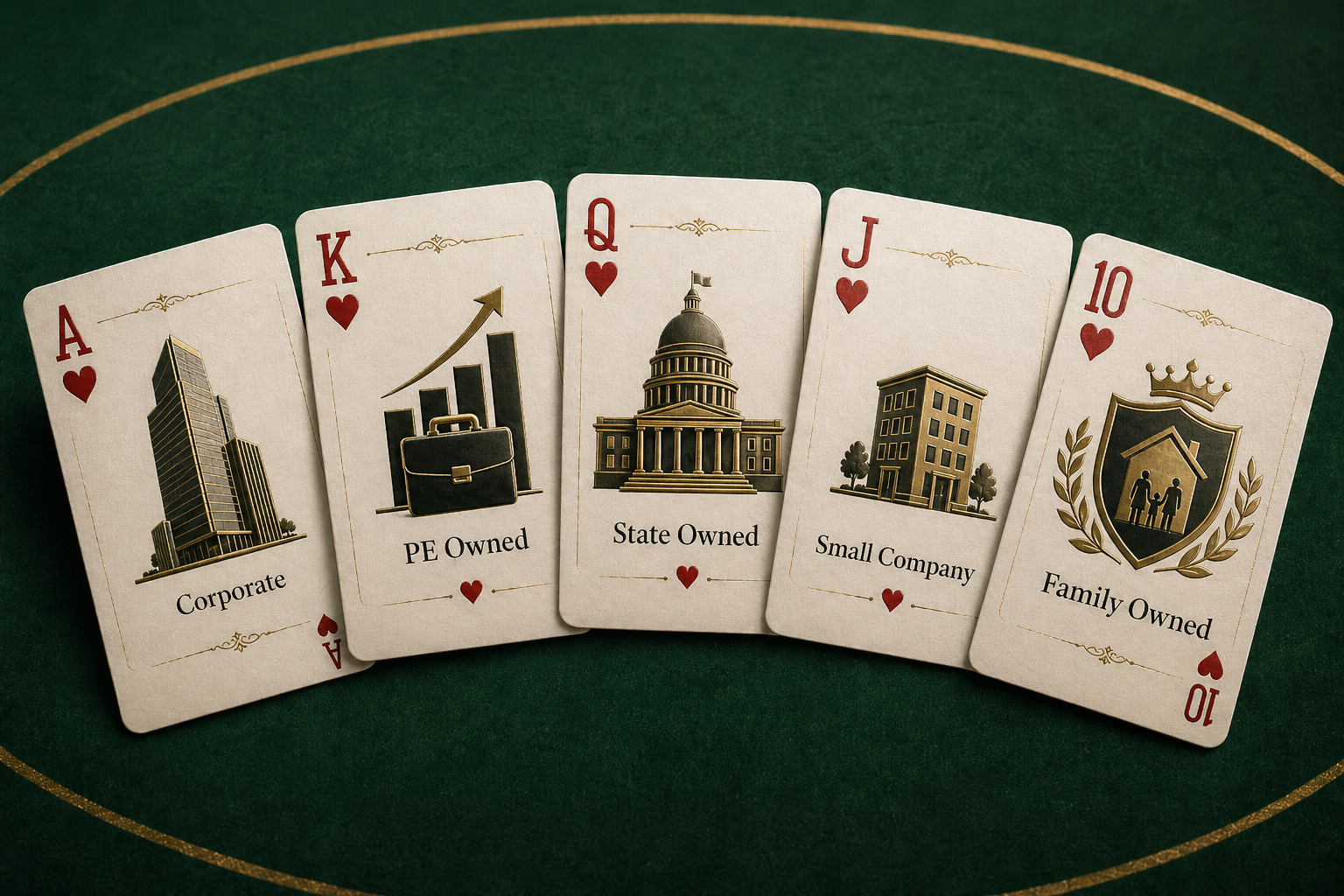
Over the course of a thirty-year career in this industry I have worked for a large listed corporation with properties across three continents, a smaller regional operator running a handful of properties in markets that most of the industry had not yet noticed, and a family-owned single property where the owner’s opinion of a particular regular customer carried more operational weight than anything in the reinvestment policy. I have consulted for properties backed by private equity, advised state-linked operators, and spent enough time inside government-run casino structures to understand why they are the way they are, even when the way they are is quietly maddening.
What struck me, moving between these worlds, was not the obvious differences. The budget sizes, the property quality, the scale of the marketing spend. It was the subtler ones. How decisions were made and by whom. How a customer was understood and valued. How staff behaved under pressure and why. What got invested in and what got quietly deferred. Each ownership model produced a recognisably different kind of operation, with its own specific strengths and its own specific blind spots, and the people working inside them were often largely unaware of how much the structure around them was shaping their behaviour.
This is an attempt to describe those differences honestly, from the inside.
The large listed corporation
The first thing a large corporate casino has that almost nothing else in this industry can match is infrastructure. Compliance systems that work. Procurement leverage that a single property operator cannot dream of. Access to capital when a market opportunity requires it. A loyalty programme that functions across multiple geographies and gives a travelling customer a genuine reason to stay inside the brand. HR policies for situations that smaller operators have never considered and, frankly, hope never to encounter.
The machine is real and it runs.
What the machine is considerably less good at is listening to itself. The distance between the casino floor and the people making strategic decisions about it tends to grow in direct proportion to the size of the company, and by the time a large listed operator reaches a certain scale, the information travelling upward through the organisation has passed through enough hands, been summarised enough times and had enough of its difficult edges removed that what arrives at the top bears a functional but occasionally misleading resemblance to what is actually happening in the building.
I spent enough time inside large corporate structures to recognise the pattern. A problem surfaces on the floor. The shift manager notes it. The department head incorporates it into a weekly summary with some context that makes it look more manageable than it is. The general manager includes a version of it in the monthly report alongside enough other information that it does not stand out. By the time the subject reaches regional management it has been so thoroughly processed that the original urgency, if there was any, has been replaced by something closer to a considered observation. Everyone has acted in good faith. The problem has still effectively disappeared.
This is not a failure of individual competence. It is a structural consequence of scale, and it affects everything from how operational problems are identified and addressed to how customers are understood and served.
The customer at a large corporate casino gets a professionally managed experience. The property is well maintained because standards exist and are monitored. The game product is current because the purchasing relationships are in place. If something goes wrong there is a process for addressing it and the process is not entirely useless. What the customer is less likely to get is the feeling that the place actually knows who he is, as distinct from what his loyalty tier says he is worth. The large corporate casino is very good at managing customer data. It is considerably less good at managing customer relationships, because relationships require continuity and continuity requires people who stay long enough to build them.
The three-year management rotation that most large operators run as standard, moving general managers between properties on a cycle that is partly developmental and partly political, ensures that the person who knew the customer, who understood the specific dynamics of the local market, who had built the relationships that produce genuine loyalty, has usually been transferred to a property in a different country by the time any of that knowledge would have been most useful.
Staff inside large corporate casinos live inside this same contradiction. The career pathways are documented. The training programmes exist and are often genuinely good. The benefits package is real. And yet the most consistent complaint from experienced operators who have worked inside large corporate structures, and who are honest enough to say so, is that they felt interchangeable. That decisions affecting their daily working life arrived from above and beyond their line of sight. That initiative, over time, gets gently discouraged by a structure that has learned to mistake caution for professionalism and compliance for competence.
The best general managers inside large corporate operations are, in a specific sense, political operators as much as they are casino operators. They understand which decisions they can make without asking, which battles are worth having in the room and which are better won quietly on the floor, and how to build enough internal credibility to buy themselves the operational room they need. The ones who have not developed that particular skill set tend to find the structure genuinely suffocating, and they are usually right.
The small or mid-size corporate
Smaller corporate operators, the regional groups running between two and ten properties typically in a specific geography or market segment, produce a recognisably different operational culture and in many respects a more interesting one.
The defining characteristic is speed. A decision that would require three meetings, two approval layers and a regional sign-off inside a large operator can be made in an afternoon. Not because the governance is weak but because the people with authority are close enough to the operation to make an informed call quickly and confident enough in their judgment to make it without assembling a committee first. When the floor needs to respond to a shift in player mix, it responds. When a VIP situation requires a hosting arrangement outside the standard parameters, the conversation goes to someone who can say yes or no rather than to a system designed to say maybe pending review.
The customer at a smaller corporate property often experiences something that large operators spend considerable sums of money trying to manufacture and never quite manage. The sense that the place is run by people who are paying attention. Staff tend to stay longer. Faces are remembered. The relationship between the property and its regular customers has a texture that a loyalty programme alone cannot produce.
The weakness is equally specific. Capital is tighter and the risk is more concentrated. One difficult year at a single property inside a two-property group is an existential conversation. One difficult year inside a twenty-property portfolio is a line in the regional report. The small corporate operator has less room for error and less ability to absorb the cost of a bad hiring decision at the top, because there is no portfolio depth to carry a weak general manager while the system looks for a replacement.
The family business
The family-owned single property casino is the ownership model that produces the most extreme outcomes in both directions. The best family casinos are genuinely remarkable operations. The worst are monuments to the dangers of unchecked instinct dressed up as experience.
What the best ones share is a quality of institutional memory that no corporate structure has yet managed to replicate. The owner who built the business from the floor up carries in his head a map of the operation that was never written down because it never needed to be. He knows which customers matter and why. He knows which members of staff are genuinely valuable and which ones have been trading on their longevity for the past four years. He knows that the air conditioning in the high limit room needs to be set two degrees cooler than the rest of the floor because the customers in there tend to play longer sessions and the room gets warm. None of this is in a manual. It lives in one person’s experience.
The customer at a well-run family casino is, at its best, a genuinely known human being rather than a revenue unit with a card. The regular customer is remembered not because a system flagged him but because someone paid attention. His preferences are understood. His habits are accommodated before he has to ask. This produces a quality of relationship that creates loyalty of a kind that a points programme cannot manufacture, because it is personal rather than transactional.
The employee at a family casino lives in close proximity to the consequences of their decisions, which is both more energising and more exposing than the corporate environment. There is no layer of management to absorb the impact of a bad call. If a shift goes badly the people responsible for it are visible. If it goes well the same is true. The owner is often in the building, which concentrates the mind in ways that a quarterly performance review from a regional manager never quite does.
The shadow side of all this is equally specific. The same qualities that make the family casino work at its best are the qualities that make it vulnerable. The culture is a direct expression of the owner’s character, which is the most efficient transmission mechanism available and also the most fragile, because it works brilliantly until the owner is no longer there, at which point the new management inherits a business whose logic is partially invisible. Things that appear arbitrary have reasons. Things that appear to have reasons are arbitrary. Separating the two takes considerably longer than anyone budgets for.
Governance is informal by design, which functions well when the owner is sharp and present and becomes genuinely dangerous when they are not. The comp that has been running for six years because the owner likes the player. The department head who has been underperforming since the previous decade because his predecessor’s relationship with the family makes the conversation too uncomfortable to have. These things accumulate in family businesses in a way that corporate structures, for all their inefficiency, tend to prevent.
And then there is succession, which is the family casino’s most reliable long-term enemy and the subject that owners of family casinos are most reliably reluctant to address until it is urgent. The conversation about what happens to the business when the founder is no longer running it is one of the most important conversations in the industry and one of the least frequently had.
Private equity
Private equity ownership is the model the industry has the most complicated feelings about, and with more justification than either side of that argument usually acknowledges.
The capital is real. The willingness to make structural changes that a family owner would find personally uncomfortable and a large corporate operator too slow to approve is also real. A PE-owned casino in the early part of a holding period can move with a speed and decisiveness that produces genuine operational improvement, particularly in properties that have been drifting inside structures too comfortable to force the necessary conversations.
The clock, however, is always running, and everyone in the building knows it.
Everything that happens inside a PE-owned casino is viewed, consciously or not, through the lens of the exit multiple and the holding period. Investment that does not contribute to EBITDA within three to four years tends not to happen. Staff development programmes that pay off in year six are structurally disadvantaged against cost reductions that show up next quarter. The customer relationship work that produces genuine loyalty over time is harder to justify in a board meeting than the promotional spend that drives visitation this month. Maintenance that extends the life of a property by a decade but requires capital now has a difficult conversation to get through.
The result is a casino that is frequently the most financially disciplined operation in its market and the most brittle underneath the surface. The numbers at exit can look genuinely impressive. The experienced operator who walks into the same property eighteen months after the transaction tends to find things that do not appear on the EBITDA bridge. A maintenance backlog deferred a year longer than was wise. A middle management layer thinned past the point where institutional knowledge is retained. A customer database treated as an asset to be monetised rather than a relationship to be developed.
The customer at a PE-owned casino rarely notices any of this directly, which is rather the point. The surface is maintained because the surface affects the valuation. What deteriorates is less visible. The depth of hosting relationships, the quality of judgment in the middle management layer, the experience that walks out the door when long-serving staff are replaced with cheaper alternatives who need eighteen months to understand the operation they have inherited.
These things do not show up until the new owner’s first full trading year. By which point the previous owner is focused on deploying the proceeds elsewhere.
The government-run casino
Government-run or state-licensed monopoly casinos exist in various forms across Europe and beyond, and they share enough characteristics to be worth examining as a category.
The stability is genuine and should not be underestimated. The regulatory clarity is real. The time horizon is effectively infinite, which allows for a quality of long-term thinking about property investment and customer relationships that no commercial operator constrained by a reporting cycle or an exit thesis can easily match. And the responsible gambling infrastructure that state operators have developed, in some cases seriously and with genuine commitment, represents a standard that commercial operators left to their own devices would rarely reach voluntarily.
What the government casino cannot manufacture is urgency, because urgency requires a threat and state monopolies by definition operate without one.
The practical consequences of this are visible everywhere in the operation. Procurement moves at institutional speed. A floor change that a private operator would implement, evaluate and either embed or reverse within a fortnight requires a process that runs for months. Innovation needs a committee, and the committee needs terms of reference, and the terms of reference need approval, and by the time the approval arrives the market has moved and the conversation starts again. This is not incompetence. It is what happens to any organisation that has not needed to move quickly and has therefore never built the muscle for it.
The customer at a government casino in a monopoly market has nowhere else to go, which is the most dangerous situation a service business can be in because it removes the primary mechanism by which service quality improves. The staff know the customer will come back. The customer knows there is no alternative. The relationship that develops from those two facts has a specific quality that anyone who has walked into a state casino in a closed market will recognise immediately. Polite. Correct. Entirely indifferent to whether you enjoyed yourself.
In markets where the monopoly has been broken and the state operator suddenly faces private competition, the adjustment is fascinating and painful in equal measure. The organisation that spent decades not needing to be responsive discovers that responsiveness is not a policy you can introduce. It is a muscle that requires years of use to develop. The private competitors, meanwhile, are already six months into understanding which customers the state operator never quite managed to make feel valued.
The employee at a government casino has genuine security and a relationship with operational pace that their counterparts in commercial operations find difficult to imagine from either direction. The structure protects its people. The people, rationally and without malice, learn to protect the structure. Initiative that falls outside defined boundaries is not rewarded and is occasionally penalised, not by anyone in particular but by the weight of an institutional culture that has never needed to encourage it.
This is not a reason to dismiss the model. It is a reason to understand what it produces and manage within it honestly rather than pretending the constraints do not exist.
What the ownership model actually determines
After thirty years of working inside most of these structures and observing the rest from close enough range to have a view, the honest conclusion is less dramatic than the preceding pages might suggest.
The ownership model determines the conditions. It sets the speed at which decisions can move, the depth of capital available, the time horizon against which investment is evaluated, the distance between the floor and the people with authority, and the culture that accumulates around all of those things over time. These are not trivial factors. They shape operations in ways that are real and consequential and often invisible to the people working inside them.
What the ownership model does not determine is the outcome.
The most reliable predictor of how well a casino actually operates, across every ownership structure I have encountered, is the quality of the person running the building day to day. A strong general manager inside a dysfunctional corporate structure finds ways to run a good operation. A weak one inside a well-resourced family business produces mediocrity that the owner’s customer relationships can sustain for years before the numbers finally say what the floor already knew.
The operator who understands the model they are working inside, its freedoms and its constraints, which battles are worth having and which are structural facts to be worked around, gets the most out of whatever hand they have been dealt. The ones who spend their careers wishing they were inside a different ownership model are usually the ones who have not yet figured out how to work effectively inside the one they are in.
The ownership model is the weather. You did not choose it and you cannot change it. Understanding it clearly is simply the difference between managing a casino and managing a casino while wondering why certain things never seem to move.
Just for different reasons, at different speeds, and with very different paperwork.