A question was put to me a few years ago that I have found myself returning to from time to time.
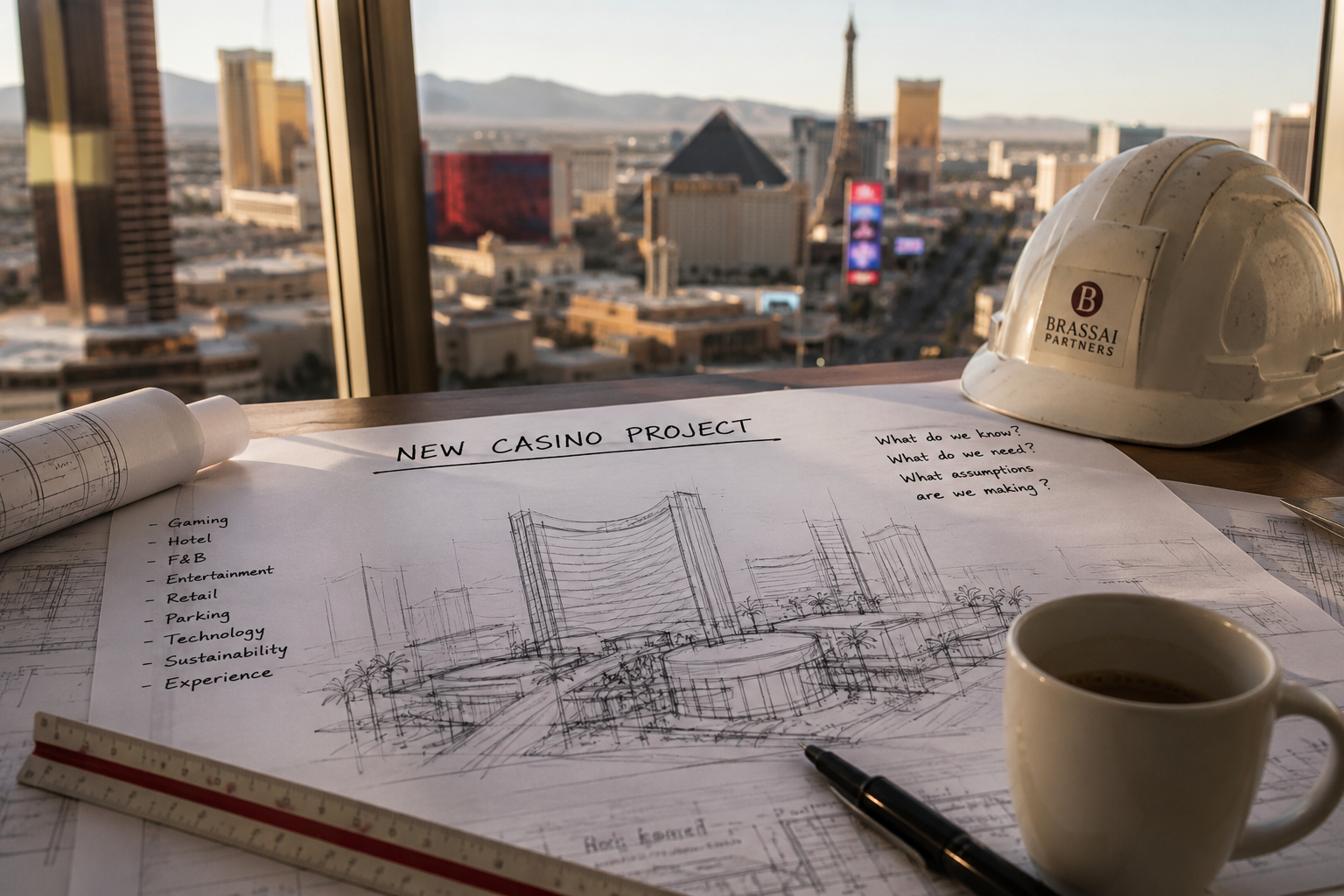
If somebody handed you the money, the licences and a suitable location tomorrow, what kind of casino would you build?
At first glance it sounds like a simple question. Most people in this industry have opinions on floor layouts, slot mixes, loyalty programmes, marketing, technology, hotels, restaurants, VIP rooms and everything else that comes with the business. Put three casino executives in a room and you will get five different casinos before the second coffee arrives.
At the time I answered the question without too much hesitation. I had been running casinos, advising casinos and walking gaming floors for most of my professional life. Of course I had ideas on what worked and what did not. Anyone who has spent long enough in this business carries a private list of things he would do differently if he ever had a clean start.
Looking back, I think I approached the question in the usual way. I started designing a better version of what I already knew.
That is probably what most of us would do. We would improve the floor. We would modernise the loyalty programme. We would avoid some of the mistakes we have seen elsewhere. We would take everything we learned from opening properties, fixing properties, arguing with finance, calming down regulators, dealing with difficult players and surviving Saturday nights, and we would put all of that experience into the new project.
Nothing wrong with that. Experience exists to be used.
But the more I think about it, the more I suspect that before designing anything I would need to spend a great deal of time questioning the assumptions sitting underneath the whole exercise.
The casino industry has changed enormously during my career. Some changes are obvious. Technology has transformed almost every part of the operation. Reporting capabilities are beyond anything we had when I started. Regulation has become more sophisticated and in many jurisdictions much more demanding. Online gaming has changed the competitive landscape completely. Customers have changed as well, although perhaps not always in the way conference presentations like to suggest.
At the same time, many of the basic assumptions behind casino design and casino management have remained surprisingly stable. We still tend to start with the gaming floor. We still organise the business around products and departments. We still build loyalty programmes around structures that have become familiar to us. We still debate centralisation and local authority using arguments that have been around for years.
I am not saying these assumptions are wrong. Many of them have earned their place. I am simply not sure we examine them often enough.
Take the gaming floor itself.
For a large part of my career, the thinking was fairly straightforward. A serious casino needed a serious floor. More positions, more tables, more machines, more choice. In growing markets that made sense. Demand was increasing, new customers were entering the market, and operators were rewarded for adding capacity. Bigger was not just a vanity project; in many cases it was a reasonable business decision.
Today I am less convinced that size is the first question I would ask.
I have visited large casinos that felt strangely lifeless and much smaller properties that generated far more energy. Sometimes this had to do with the product, sometimes with the market, sometimes with management, sometimes with things that are harder to describe. What stayed with me was that customers did not seem to care about the same things we measured.
We talk about positions, utilisation, product mix and yield. We have to. Those are the tools of the business. But customers decide something much simpler. Did they enjoy being there? Did the place feel alive? Did they feel looked after? Did the night work for them?
If I were starting from a blank sheet of paper, I would still care about the numbers, of course. I would just be careful not to confuse capacity with relevance. A floor can be full of product and still fail to create a reason to stay.
The way we organise casinos would be another area worth examining. Most properties are structured around products and functions, which is understandable. Slots require specific knowledge. Tables require specific knowledge. Surveillance, marketing, finance, compliance and operations each have their own logic and responsibility. Casinos are complicated businesses and specialisation is not optional.
Yet customers do not experience the property according to our organisational chart.
They come for a night out, a few hours of play, a social routine, a premium experience, a meal followed by some gaming, or sometimes just because the casino is part of their life. They move through the building in ways that are often more fluid than our internal structures. A decision made in marketing can create a problem on the floor. A control designed by finance can affect the guest experience. A host promise can land at the cage at the wrong moment. We all know this, yet many properties still behave as if departments are separate worlds that only meet in meetings.
If I were starting from scratch, I would want to know whether we are organising the property for ourselves or for the customer. I suspect the answer would not always be comfortable.
Loyalty programmes are another good example. I have spent enough years around player development and customer segmentation to respect what good loyalty systems can do. The industry has become much better at understanding player behaviour. We can identify patterns, measure reinvestment, model value and communicate with guests in ways that would have looked almost magical when I started.
Still, I occasionally sit through loyalty discussions where the system feels more sophisticated than the thinking behind it.
A tier structure can look impressive. A campaign can be perfectly segmented. A dashboard can show every movement in the customer base. The question remains whether the guest feels more valued, whether behaviour changes, and whether the company makes better decisions because of it.
That is where I would pause. If we started again today, with everything we know about data, psychology, convenience, privacy and customer expectations, would we build loyalty programmes in the same way? Perhaps we would. Perhaps not. I only know that I would not accept the current model simply because it is the one most of us inherited.
Centralisation is another subject I find myself thinking about more often these days.
The industry did not move in that direction by accident. Larger operators needed consistency. Reporting had to improve. Controls had to improve. Procurement became more efficient. Compliance became easier to manage when standards were shared across properties. I have seen enough poorly controlled operations to understand the appeal of a strong central structure.
At the same time, I remember a period when casino managers knew their local markets in a way that rarely appears in a report. They knew which local businesses were thriving, which regular players were changing habits, which competitor promotion was making noise in town, and which busy night only looked good because the right people happened to be in the building.
Some of that knowledge was subjective. Some of it was biased. Some of it was probably wrong. But much of it was useful because it was close to the customer and close to the floor.
Today we have access to more information than ever before, yet I sometimes wonder whether observation has weakened. We have become very good at analysing customers and sometimes less patient about simply watching them. The strongest operators I know do both. They use data properly, but they do not allow it to replace curiosity. They understand the report and still walk the floor.
If I were building from scratch, I would spend a lot of time deciding where decisions should sit. The closer a decision is to risk, governance and compliance, the more consistency matters. The closer it is to the customer, the more dangerous it becomes to remove judgment completely from the property. Finding that balance may be one of the more important design decisions, even though it would never show up on an architectural drawing.
Technology would require the same kind of caution.
Every decade arrives with a promise that the next wave of technology will change the business. Sometimes it does. More often it improves a few things, creates a few new problems and then quietly becomes part of daily operations. I have seen systems sold as revolutionary become another screen that managers look at once a week.
AI is the current example, and I have no doubt casinos will use it more and more. Some already are. The useful question is not whether the technology is impressive. It often is. The useful question is whether it solves problems that matter to operators.
Casinos have never been short of information. Many properties already produce more analysis than management teams can digest properly. The weak point has usually been the distance between information and action. If AI shortens that distance, it will create value. If it simply produces faster summaries, smarter reports and more recommendations that nobody has the authority or confidence to act on, it will become another expensive layer on top of existing habits.
This is where a blank sheet of paper becomes useful. It forces you to ask whether technology is being added to a clear operating model or whether it is expected to compensate for the absence of one.
People would probably worry me more than technology.
Not headcount. Knowledge.
A surprising amount of casino expertise exists only inside people’s heads. Some of the most useful lessons I learned were never written in manuals. They came from experienced managers, supervisors, dealers, regulators, marketers and finance people who had accumulated years of practical experience and were willing to share it. Usually not in formal settings. More often in conversations after a difficult night, during an opening, after a mistake, or while trying to understand why something that should have worked did not.
A lot of that generation is leaving the industry or has already left. When they go, knowledge goes with them. Companies may keep the procedures, but procedures are not the same as experience.
This is one of the reasons Qasiknow matters to me. The idea was never complicated. There are people in this industry who know things worth sharing, and there are younger managers who rarely get access to that knowledge unless they happen to work under the right person at the right time. We have become better at training people in rules, systems and compliance. I am not sure we have become better at passing on judgment.
If I were building a casino today, I would think very seriously about how knowledge moves through the organisation. Not just how staff are trained in their current jobs, but how future managers learn to think about the business.
Premium gaming is another area where a blank sheet would be useful.
For years, the formula was familiar. Privacy, exclusivity, better finishes, more personal attention, separate spaces and a physical environment that made importance visible. In many markets that made sense and still does. Human nature has not changed as much as some people pretend. Recognition matters. Privacy matters. Status matters.
But I have also met premium players who cared very little for the traditional signals and cared a great deal about convenience, flexibility, discretion and being left alone when they wanted to be left alone. Some wanted to be seen. Others wanted precisely the opposite.
If I were designing premium gaming today, I would be careful about copying the past too literally. I would want to understand what premium means to the next generation of customers, not only what it meant to the previous one.
The same applies to entertainment.
Casinos spent years broadening the offer. Hotels improved, restaurants improved, live entertainment improved, non-gaming revenue became more important. In many markets this was necessary and healthy. The casino became less isolated and more integrated into a broader leisure experience.
Yet I am not sure every operator has decided where gaming sits in that wider offer. For some, gaming remains the centre of gravity and everything else supports it. For others, gaming is one element in a larger entertainment business. Both approaches can work, but they lead to very different decisions.
A property cannot avoid that question forever. The answer affects investment, staffing, marketing, design and the type of customer you build the business around.
The most difficult part of the whole exercise is probably the customer we have not met yet.
Every generation of managers believes it understands its customers reasonably well. Most of the time that belief is justified because the customers in front of us can be observed, measured and spoken to. The harder task is thinking about the people who are not yet customers, or not yet old enough, or not yet interested in what we offer.
During my career I have watched the industry adapt to changes in demographics, technology and social behaviour. Sometimes we adapted quickly. Sometimes we were late. Looking back, one mistake appears again and again in different forms: we assume the future customer will behave broadly like the current one.
Sometimes that assumption survives. Sometimes it does not.
If I were building something expected to remain relevant for twenty years, I would probably spend as much time thinking about future customers as I would about current competitors. Forecasting is unreliable, but ignoring the question is worse.
The more I think about the original question, the less I see it as a design exercise.
If somebody handed me that blank sheet tomorrow, I doubt the first hours would involve floor plans, machine counts or hotel room numbers. I would probably start by writing down the assumptions I carry from thirty years in the business and forcing myself to defend them.
Some would survive easily. Others would not.
That would be the useful part.
Because the casino I would eventually build is less interesting than the assumptions I would have to abandon before building it.
And perhaps that is where the real value of the question sits.